



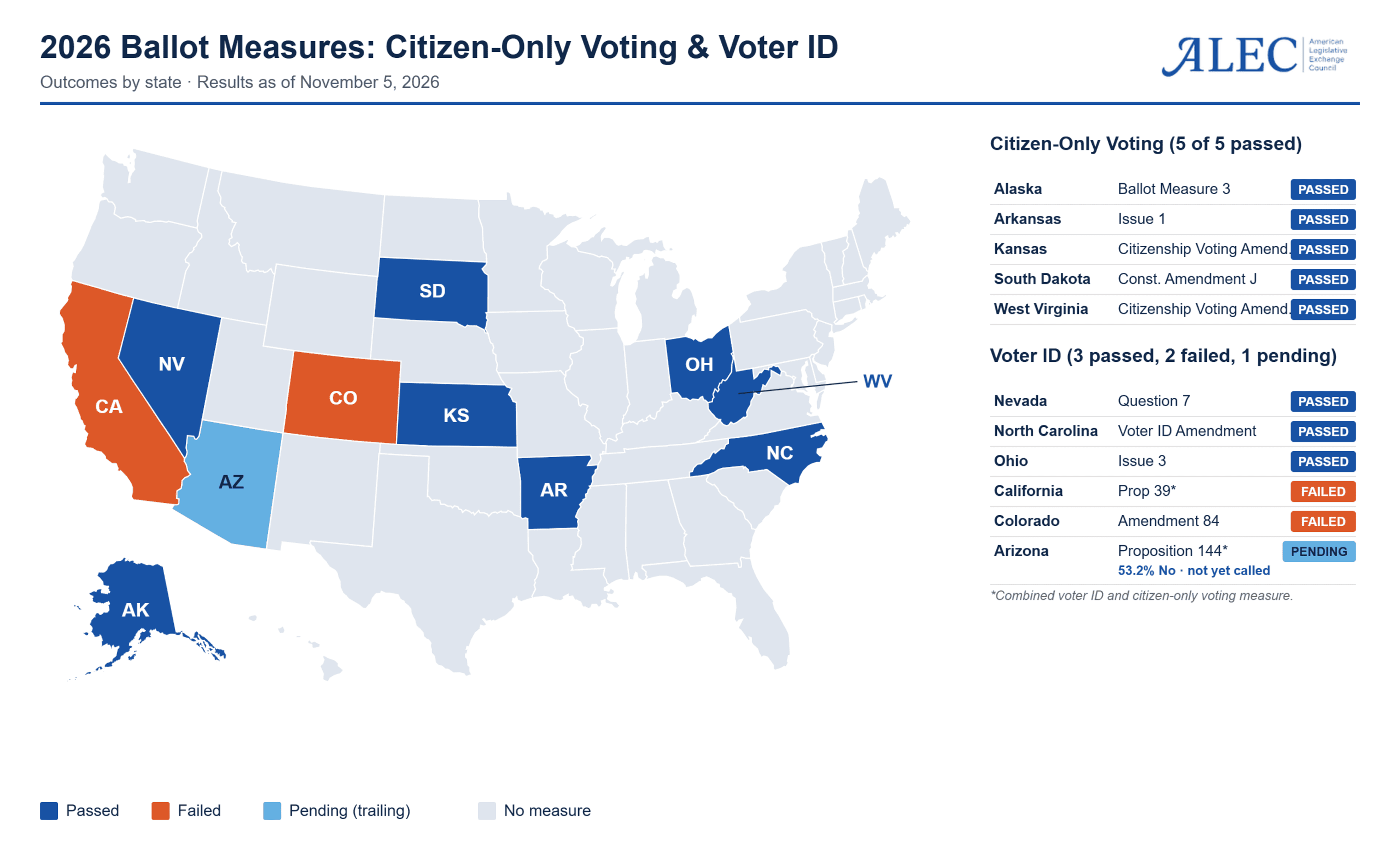
Election integrity and ALEC principles won in Tuesday’s midterms as voters approved citizen-only voting measures in West Virginia, South Dakota, Kansas, Alaska, and Arkansas, along with voter-ID measures in Ohio, North Carolina, and Nevada, reflecting support for a straightforward approach to election policy.
Tuesday’s results sent a strong message: the electorate wants clear rules, verified eligibility, and the protection of the integrity of every lawful vote. That approach is central to ALEC’s election policy work, which emphasizes both access for eligible voters and safeguards that protect the voting process.
Citizenship Should Be Clear in the Law
The victories in West Virginia, South Dakota, Kansas, Alaska, and Arkansas affirmed that citizenship is a defining qualification for participation in American elections. Their significance lies in making the citizens-only requirement explicit and, in four states, giving it constitutional protection. That direction aligns with ALEC’s emphasis on clearly established eligibility rules. ALEC’s Eligibility Verification and Documentary Proof of Citizenship for Registration Requirements Act provides a framework for verifying citizenship during voter registration. Eligibility requirements should be meaningful rules that election officials can administer, not merely assumptions.
Voter Identification Earns Voter Support
The wins in Ohio, North Carolina, and Nevada likewise reflect the principles embedded in ALEC’s Valid Voter Identification Act. Verifying identity is a legitimate part of administering an election. In testimony earlier this year, I described voter access and election security as complementary goals, pointing to photo identification alongside measures such as free identification cards and provisional ballot options. Tuesday’s results gave that philosophy a concrete expression at the ballot box. In three states, voters explicitly chose identification requirements designed to verify who is casting a ballot. These were separate state decisions, but they shared a common principle—election rules should be clear and enforceable.
A Mandate to Turn Principles Into Practice
These results are victories for election integrity. Ideas championed by ALEC won approval when voters considered them directly. While citizen voting and voter ID laws did not get across the finish line in California, Colorado, or Arizona, Tuesday’s message was clear. In eight states, voters backed stronger citizenship or identification provisions. For ALEC and state leaders who share its election-integrity principles, those results offer a foundation for continued work—and a responsibility to deliver election systems that are both accessible and secure.