
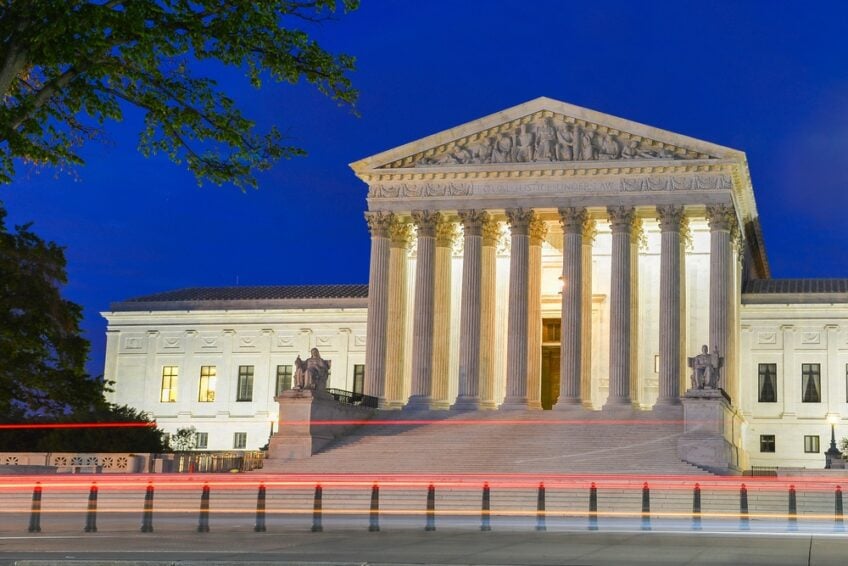
Climate Lawsuits Reach the Supreme Court—with States Closely Watching
The Supreme Court heard arguments in Suncor on Oct. 5, and its decision could help define the boundaries of state-law climate liability nationwide.
The U.S. Supreme Court began its new term with a case that could shape the future of climate litigation nationwide. In Suncor Energy (U.S.A.) Inc. v. County Commissioners of Boulder County, the justices will determine whether federal law prevents state courts from requiring energy companies to pay for local harms allegedly tied to global greenhouse-gas emissions.
The case began in 2018 when Boulder County and the City of Boulder sued ExxonMobil and Suncor Energy under Colorado law. The local governments allege that the companies contributed to climate change, misled the public about their products’ risks, and should help pay for costs associated with wildfires, flooding, damaged infrastructure, and other local impacts. The surviving claims include public nuisance, private nuisance, trespass, unjust enrichment, and civil conspiracy.
The companies argue that issues involving emissions across state and national borders belong under federal, rather than individual state, authority. The primary question before the High Court is whether federal law precludes such state-law claims seeking relief for alleged global climate impacts. Beyond the immediate legal questions, Suncor represents a growing nationwide trend of state and local governments using traditional tort claims to pursue damages for the alleged consequences of global emissions.
In September 2026, Reuters reported that ExxonMobil and Suncor had identified nearly 60 state and local governments that brought comparable lawsuits seeking billions of dollars. The theories differ, but the practical objective is similar: obtain compensation from energy companies for alleged climate-related impacts in a global emissions context.
While the litigation is widespread, it is not moving uniformly. Honolulu pursued climate-related claims against oil companies, yielding a victory at the Hawaii Supreme Court on the federal preemption question. Similarly, Chicago took home a major federal appellate victory in its climate suit, where the Seventh Circuit rejected the defendant’s attempt at federal removal. However, in March 2026, Maryland’s highest court upheld the dismissal of climate claims brought by Baltimore, Annapolis, and Anne Arundel County. In April, a California court paused coordinated climate cases while awaiting the U.S. Supreme Court’s decision in Suncor. Further, the U.S. Department of Justice has taken legal action against several states and municipalities—including Hawaii, Michigan, New York, and Vermont—seeking to block these very climate suits.
At their core, these suits seek to extract billions from energy producers for alleged harms too remote to support traditional tort claims. The nature of these suits highlights an important federalism concern: while states retain significant authority over energy and environmental policy within their borders, allowing a single state court to impose liability based on worldwide emissions could produce regulatory and economic consequences extending far beyond that state’s jurisdiction. Those consequences could affect far more than the individual companies named in these lawsuits. A patchwork of potentially billions of dollars in state and local liability could create greater uncertainty for domestic energy production and investment, with implications for infrastructure development, energy supply and, ultimately, the prices paid by families and businesses. A single multibillion-dollar verdict could influence energy markets and business decisions nationally and globally—all initiated by one individual city. Perhaps most concerning, however, is that these far-reaching consequences—jurisdictional overreach, regulatory repercussions, and financial penalties extending across the global energy industry—are not merely haphazard consequences of the notorious municipal climate lawsuit; they are its intended objective.
Litigation with such ambition thrives in the absence of democratic policymaking. Major policy decisions carrying consequences for energy affordability and reliability are better addressed transparently by elected lawmakers through clearly defined statutes and regulations rather than developed piecemeal through litigation.
The ALEC model Energy Security and Independence Act would bar claims seeking relief for the alleged effects of climate change against businesses lawfully engaged in fossil fuel production. Taking a broader approach, the ALEC model Energy Producers and Consumers Protection Act protects covered lawful energy, agricultural, and industrial activities against specified climate-related liability for covered conduct, and includes an exception requiring proof of a specific federal environmental-law violation and direct, identifiable harm. Both models aim to keep major energy-policy decisions with elected lawmakers and to curb frivolous litigation targeting an industry indispensable to the fundamental operation of American society.
The diversity among the states in how standard tort liability is applied, combined with the complexity of the federal-state entwinement, underscores the magnitude of the impending Suncor outcome. The Supreme Court heard arguments in Suncor on Oct. 5, and its decision could help define the boundaries of state-law climate liability nationwide. Whatever the Court decides, state legislatures will have greater reason to examine where environmental enforcement ends and open-ended climate liability begins. As lawsuits and legislative proposals continue to develop, states can be expected to debate and define clearer rules for lawful energy activity, civil liability, and the proper role of the judiciary in energy production.