


Created in 1996 as “qualified state tuition programs,” 529 plans have become a crucial savings tool for American families navigating the high cost of a college education. Families invest in a 529 savings account, earnings grow tax-deferred, and withdrawals are federally tax-free when used for qualified education expenses. As of December 31, 2025, there were about 16.9 million active 529 savings accounts holding $576.7 billion in assets.1 In addition to the federal benefits, many states offer their own tax incentives for contributions.
The Tax Cuts and Jobs Act (TCJA) expanded the list of eligible 529 expenses in 2018 by allowing up to $10,000 in K–12 tuition costs per account per year. The Working Families Tax Cuts Act, signed into law on July 4, 2025, took this even further by doubling the annual limit on K-12 spending to $20,000 and adding a host of new K-12 expenses as allowable. These newly eligible expenses include curriculum, instructional materials, tutoring services, testing and dual-enrollment fees, and educational therapies for students with disabilities.
While these K-12 expenses qualify for federal tax benefits, not all states treat them as allowable for state tax benefits. Depending on how a state’s law is written, it is possible that well-meaning families who spend their 529 funds on a federally-allowable 529 expense could face recapture of their state tax incentives and be forced to pay additional penalties. For example, Arkansas code explicitly allows K-12 expenses permitted under Section 529 as of January 1, 2024. At that time, Section 529 included K-12 tuition as a qualified expense up to $10,000 per year, but did not include any additional K-12 expenses. As a result, Arkansas only permits spending on K-12 tuition up to a maximum of $10,000 per year, despite the recent federal changes.
We strongly encourage state lawmakers to ensure that their 529 program allows families to spend funds on any federally authorized expenses.
This report examines the differences that policymakers should address: restrictions on K–12 tuition, narrow treatment of non-tuition expenses, limits on contribution incentives, and unresolved or inconsistent guidance. We strongly encourage state lawmakers to ensure that their 529 program allows families to spend funds on any federally authorized expenses. This eliminates confusion among families about what they can spend their 529 money on and, more importantly, prevents any well-meaning parent from being hit with a state tax penalty on an otherwise federally eligible expense.
Key Findings
We have identified 16 states whose 529 laws and guidance do not permit all of the K-12 expenses now allowed under federal law. 11 of those states, including California, Colorado, Delaware, Hawaii, Illinois, Michigan, Minnesota, Nebraska2, New York, Oregon, and Vermont, do not permit any K-12 expenses whatsoever. Three states, including Arkansas, Kentucky, and Louisiana, allow only K-12 tuition costs up to $10,000 per year. The remaining two states, Indiana and Montana, allow only K-12 tuition costs up to $20,000 per year.
It is important to note that Congress allowed K-12 expenses in 529 accounts by creating section 529(c)(7), which states that “any reference in this section to the term ‘qualified higher education expense’ shall include a reference to the following [K-12] expenses…” Therefore, states who defined their list of allowable expenses to include all “qualified higher education expenses” listed in section 529 should automatically include K-12 costs. Despite this, we identified four states, including Hawaii, Michigan, New York, and Vermont, who are denying K-12 expenses even though their statutory definitions incorporate section 529 in its entirety.
Alaska, Florida, Nevada, New Hampshire, South Dakota, Tennessee, Texas, Washington, and Wyoming do not impose an individual income tax and therefore do not offer a tax incentive for 529 contributions.
States that Allow Some, But Not All, K-12 Expenses
Arkansas: A.C.A. § 6-84-103 defines “qualified higher education expenses” to include “tuition and other permitted expenses as set forth in 26 U.S.C. § 529, as in effect on January 1, 2024.” This means that the TCJA’s expansion of K-12 tuition up to $10,000 per year is permitted in Arkansas, but the expanded list of K-12 expenses and higher annual limits are not.
Indiana: IC § 6-3-3-12 defines a “qualified K-12 education expense” to include “expenses that are for tuition…at an elementary or secondary public, private, or religious school.” Since non-tuition expenses are excluded from the definition, they do not currently qualify as allowable expenses under Indiana law.
Kentucky: KY Rev. Stat. § 164A.305 defines “qualified education expenses” to include the higher education expenses listed in section 529 as well as “tuition of up to $10,000 per year” for K-12 expenses. This definition incorporates the TCJA’s expansion of 529s, but not the expansion in the Working Families Tax Cuts Act.
Louisiana: LA Rev. Stat. § 17:3092 defines “qualified higher education expenses” as having the same meaning “as that term is defined in 26 U.S.C. § 529(e)(3).”
Montana: State law broadly empowers the Family Education Savings Account Program Oversight Committee with authority over the 529 program and what expenses are allowed. Currently, the Montana 529 website states that “up to $20,000 of tuition for enrollment at an elementary or secondary public, private, or religious school” is allowed. Non-tuition expenses are not addressed here and presumed disallowed.
States that Disallow All K-12 Expenses
California: CA Educ Code § 69980 allows a variety of specific higher education expenses without tying the definition to section 529 as it exists today. It also empowers the state’s Scholarship Investment Board to reject new expenses added to section 529 if they determine the expenses are inconsistent with the program’s purpose.
Colorado: C.R.S. § 23-3.1-302 defines a “qualified higher education expense” to include those listed in section 529(e)(3). Since the K-12 expenses are listed in section 529(c)(7), the statutory definition does not include any K-12 expenses.
Delaware: Delaware stands on its own as the only state with an explicit prohibition on tax benefits for K-12 expenses. 30 Del. C. § 1106 states that “no deduction shall be permitted under this section for any amount contributed…for expenses intended or used for tuition in connection with enrollment or attendance at an elementary or secondary…school.”
Illinois: 15 ILCS 505/16.5 lists a variety of approved higher education expenses without directly incorporating section 529 itself. As a result, no K-12 expenses are permitted under the state’s definition of a qualified higher education expense.
Minnesota: Minn. Stat. § 136G.03 defines a “qualified higher education expense” to include those listed in section 529(e)(3). Since the K-12 expenses are listed in section 529(c)(7), the statutory definition does not include any K-12 expenses.
Nebraska: Nebraska law does not contain specific program definitions and empowers the State Treasurer with broad authority over the state’s 529 program. K-12 expenses are not an allowable expense at this moment, but the state has written that they intend to include these expenses, along with the $20,000 annual withdrawal limit, beginning on January 1, 2029.
Oregon: ORS § 178.300 defines “qualified higher education expenses” to include those listed in section 529(e), section 529(c)(8), and section 529(c)(9). Since the K-12 expenses are listed in section 529(c)(7), the statutory definition does not include any K-12 expenses.
States that Disallow All K-12 Expenses, but have Inconsistencies Between Statute and Implementation
Hawaii: HI Rev Stat § 256-1 defines permitted expenses as “any qualified higher education expense defined in section 529 of the Internal Revenue Code of 1986, as amended, or successor legislation.” This definition would appear to include all K-12 expenses added by the TCJA and Working Families Tax Cuts Act. However, the state’s program website currently notes that “withdrawals used to pay for K-12 tuition expenses…are considered a Hawaii non-qualified withdrawal [and] subject to Hawaii state income tax.”
Michigan: MI Comp L § 390.1472 defines “qualified higher education expenses” to match the term’s definition in section 529. Despite this, the Michigan 529 website notes that “withdrawals for tuition expenses at a public, private, or religious elementary, middle, or high school can be withdrawn free from federal taxes. For Michigan taxpayers, these withdrawals are subject to recapture of Michigan income tax deduction and state income tax on the earnings.”
New York: § 695-B of New York’s education code also defines “qualified higher education expenses” to include all “qualified higher education expenses as provided under 26 U.S.C. § 529.” However, the state’s 529 program site says “The New York State Department of Taxation and Finance (DTF) has determined that K-12 tuition expenses are considered nonqualified withdrawals for New York State tax purposes.” It also notes that DTF has yet to rule on the treatment of non-tuition K-12 expenses.
Vermont: 16 V.S.A. § 2876 lists “qualified higher education expenses as provided under 26 U.S.C. § 529” as allowable. However, the state’s 529 program site says that “withdrawals for qualified K-12 expenses are subject to Vermont state tax credit recapture.”
State Tax Consequences for Families
A family may incur state tax consequences even when a withdrawal is fully qualified under federal law. Depending on the state, those consequences can include recapture of earlier contribution deductions or credits, imposition of state income tax on earnings, or an additional tax/penalty.
California illustrates the potential cost of this problem. Even though the state does not offer a tax deduction or credit for contributions to a 529 account, it will impose income taxes on withdrawals for K-12 expenses. In addition, California imposes an addition 2.5% tax penalty on such a withdrawal. This is an incredibly steep financial penalty to impose on families who otherwise believed their withdrawal was permitted since it was for a qualified federal expense.
Between all of the states discussed above, there are 4,702,438 accounts with $161,267,188,695 in assets under management as of December 31, 2025 (details in table below). The significant size of these 529 programs further underscores the need for policymakers to ensure their state programs are aligned with the expenses permitted by federal law.
| Sponsoring State | Savings Accounts | Assets Under Management |
|---|---|---|
| Arkansas | 56,418 | $1,629,485,025 |
| California | 487,145 | $19,151,237,239 |
| Colorado | 430,434 | $14,402,897,649 |
| Delaware | 27,553 | $748,172,706 |
| Hawaii | 6,685 | $132,692,733 |
| Illinois | 644,987 | $24,272,609,661 |
| Indiana | 464,833 | $8,939,792,827 |
| Kentucky | 20,031 | $332,359,367 |
| Louisiana | 89,246 | $1,937,386,297 |
| Michigan | 394,510 | $11,037,204,855 |
| Minnesota | 110,861 | $2,368,178,570 |
| Montana | 13,767 | $264,415,447 |
| Nebraska | 305,831 | $7,873,225,073 |
| New York | 1,389,771 | $61,523,813,716 |
| Oregon | 228,720 | $5,842,579,713 |
| Vermont | 31,646 | $811,137,817 |
| Total | 4,702,438 | $161,267,188,695 |
Source: College Savings Plans Network, reporting date December 31, 2025.
2 Nebraska does not currently permit any K-12 expenses, but they do intend to allow those expenses beginning in 2029.
Policy Recommendations
State policymakers should align their 529 statutes, income tax rules, and program guidance with the full federal definition of qualified expenses. This means allowing up to $20,000 per year in K-12 expenses like tuition, curriculum, instructional materials, online education materials, tutoring, testing fees, dual enrollment fees, and therapies for students with special needs.
States should also make clear in statute, regulation, or official guidance whether the federal K–12 expansion applies for state tax purposes, including whether prior contribution deductions or credits remain protected. Clear rules will reduce surprises for families and simplify administration. This is especially true in states like Hawaii, Michigan, New York, and Vermont where K-12 expenses are not permitted despite statutory definitions to the contrary.
ALEC’s 529 Education Freedom for States Act offers a model to achieve these recommendations. It calls for continuing conformity with federal Section 529, equal state and federal treatment of qualified distributions, and protection against state tax or recapture on federally qualified withdrawals.
The TCJA and Working Families Tax Cuts Act have created a massive opportunity for states to expand education freedom. Students and their families should not only be allowed to use their hard-earned 529 savings for federally-eligible K-12 expenses, but they should also be free from any unanticipated financial harm that a state might impose on them for doing so.
Resources
Read ALEC’s 529 Education Freedom for States Act Model Policy and other ALEC resources.
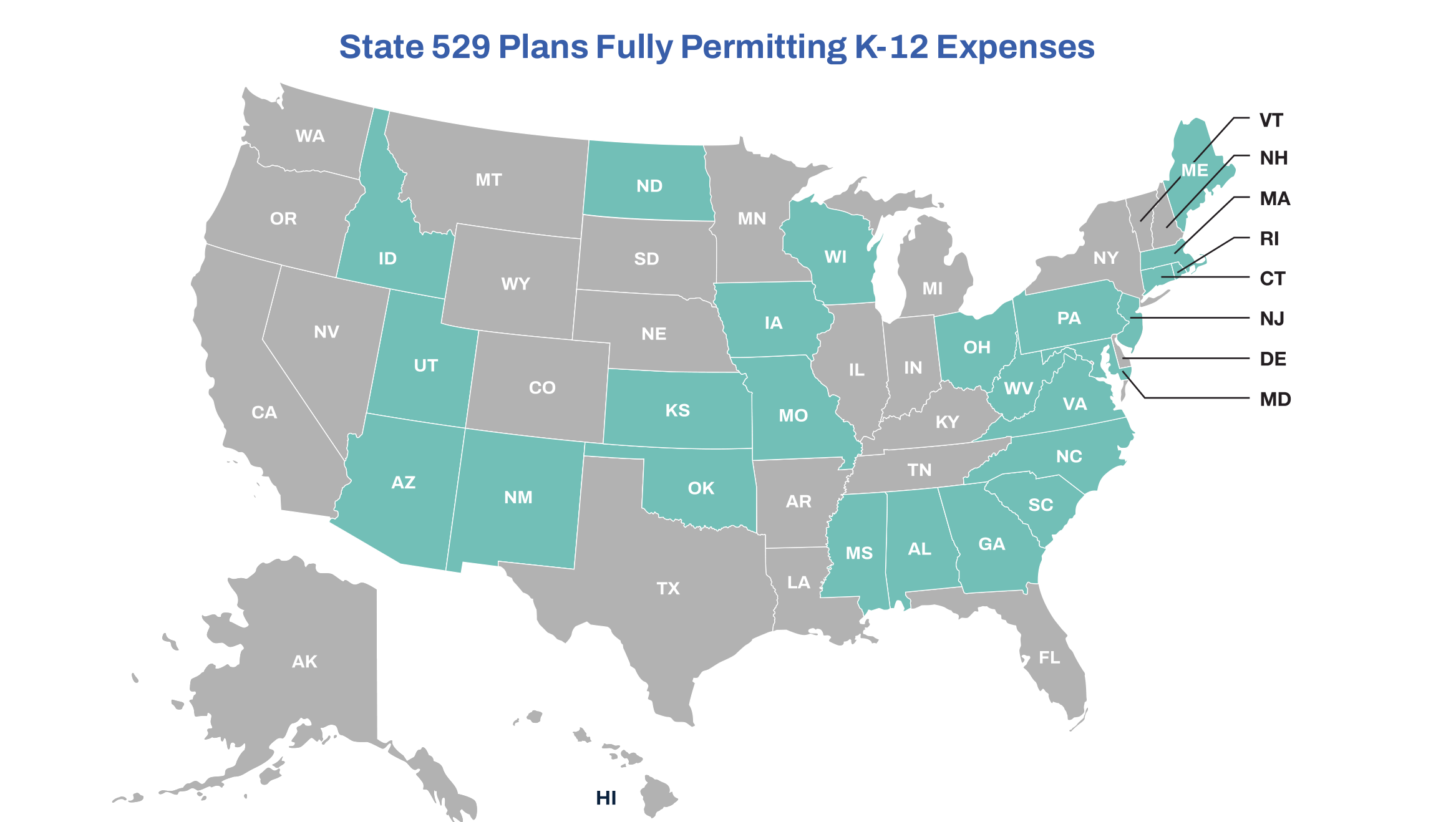
State 529 Plans Fully Permitting K-12 Expenses
State 529 Tax Treatment Table
| State | Incentive | Single Filer | Joint Filers | Benefit Basis | K–12 Tuition3 | Full K–12 Expenses | Statutory References & Sources |
|---|---|---|---|---|---|---|---|
| Alabama | Deduction | $5,000 | $10,000 | Total | Yes | Yes | AL Code § 16-33C-10; AL Code § 40-18-15 |
| Alaska | No individual income tax | ||||||
| Arizona | Deduction | $2,000 | $4,000 | Per Account | Yes | Yes | Ariz. Rev. Stat. § 15-1871.12; Ariz. Rev. Stat. § 43-1022(19) |
| Arkansas4 | Deduction | $5,000 | $10,000 | Total | Partial | No | A.C.A. § 6-84-103; A.C.A. § 6-84-111 |
| California | None | — | — | — | No | No | CA Educ Code § 69980 |
| Colorado | Deduction | $26,200 | $39,200 | Per Account | No | No | C.R.S. § 23-3.1-302; C.R.S. § 39-22-104 |
| Connecticut | Deduction | $5,000 | $10,000 | Total | Yes | Yes | § 3-22f; § 12-701 |
| Delaware | Deduction | $1,000 | $2,000 | Total | No | No | 14 Del. C. § 3485; 30 Del. C. § 1106 |
| Florida | No individual income tax | ||||||
| Georgia | Deduction | $4,000 | $8,000 | Per Account | Yes | Yes | O.C.G.A. § 20-3-632; O.C.G.A. § 48-7-27 |
| Hawaii | None | — | — | — | No | No | HI Rev Stat § 256-1 |
| Idaho | Deduction | $6,000 | $12,000 | Total | Yes | Yes | ID Code § 33-5401; ID Code § 63-3022 |
| Illinois | Deduction | $10,000 | $20,000 | Total | No | No | 15 ILCS 505/16.5; 35 ILCS 5/203 |
| Indiana5 | Credit | 20%; max $1,500 | 20%; max $1,500 | Total | Yes | No | Ind. Code § 6-3-3-12; Indiana Department of Revenue |
| Iowa | Deduction | $6,100 | $12,200 | Per Account | Yes | Yes | IA Code § 12D.1; IA Code § 12D.3 |
| Kansas | Deduction | $3,000 | $6,000 | Per Account | Yes | Yes | KSA § 75-643; KSA § 79-32-117 |
| Kentucky6 | None | — | — | — | Partial | No | KY Rev. Stat. § 164A.305 |
| Louisiana7 | Deduction | $2,400 | $4,800 | Per Account | Partial | No | LA Rev. Stat. § 17:3092; LA Rev. Stat. § 47:293; LA START Saving Program |
| Maine | Deduction | $1,000 | $1,000 | Per Account | Yes | Yes | 20-A ME Rev Stat § 11471; 36 ME Rev Stat § 5122 |
| Maryland | Deduction | $2,500 | $5,000 | Per Account | Yes | Yes | MD Education Code § 18-1901; MD Tax - General Code § 10-208 |
| Massachusetts | Deduction | $1,000 | $2,000 | Total | Yes | Yes | MA Gen L ch 15C § 5B; MA Gen L ch 62 § 3 |
| Michigan | Deduction | $5,000 | $10,000 | Total | No | No | MI Comp L § 390.1472; MI Comp L § 206.30 |
| Minnesota8 | Credit | 50%; max $500 | 50%; max $500 | Total | No | No | Minn. Stat. § 136G.03; Minn. Stat. § 290.0684 |
| Minnesota | Deduction | $1,500 | $3,000 | Total | No | No | Minn. Stat. § 136G.03; Minn. Stat. § 290.0132 |
| Mississippi | Deduction | $10,000 | $20,000 | Total | Yes | Yes | Miss. Code Ann. § 37-155-105; Miss. Code Ann. § 37-155-113 |
| Missouri | Deduction | $8,000 | $16,000 | Total | Yes | Yes | RSMo § 166.410; RSMo § 166.435 |
| Montana9 | Deduction | $4,600 | $9,200 | Total | Yes | No | MCA § 20-25-901; MCA § 15-30-2120; Montana Department of Revenue |
| Nebraska10 | Deduction | $10,000 | $10,000 | Total | No | No | Neb. Rev. Stat. § 77-1417; Neb. Rev. Stat. § 77-2716; NEST 529 |
| Nevada | No individual income tax | ||||||
| New Hampshire | No individual income tax | ||||||
| New Jersey | Deduction | $10,000 | $10,000 | Total | Yes | Yes | N.J.S.A. 18A:71B-36; N.J.S.A. 54A:3-12; New Jersey Division of Taxation Notice |
| New Mexico | Deduction | Unlimited | Unlimited | Total | Yes | Yes | NM Stat. § 21-21K-2; NM Stat. § 7-2-32 |
| New York | Deduction | $5,000 | $10,000 | Total | No | No | Education § 695-B; Tax § 612; NY’s 529 College Savings Program |
| North Carolina | None | — | — | — | Yes | Yes | N.C. Gen. Stat. § 116-209.25 |
| North Dakota | Deduction | $5,000 | $10,000 | Total | Yes | Yes | N.D. Cent. Code § 6-09-38; N.D. Cent. Code § 57-38-30.3 |
| Ohio | Deduction | $4,000 | $4,000 | Per Account | Yes | Yes | Ohio Rev. Code § 3334.18; Ohio Rev. Code § 5747.70 |
| Oklahoma | Deduction | $10,000 | $20,000 | Total | Yes | Yes | 70 O.S. § 3970.3; 68 O.S. § 2358 |
| Oregon | Credit | Up to $190 | Up to $380 | Total | No | No | ORS § 178.300; ORS § 315.650 |
| Pennsylvania | Deduction | $19,000 | $38,000 | Per Account | Yes | Yes | 24 P.S. § 6901.302; 72 P.S. § 7303(a.7) |
| Rhode Island | Deduction | $500 | $1,000 | Total | Yes | Yes | R.I. Gen. Laws § 16-57-3; R.I. Gen. Laws § 44-30-12 |
| South Carolina | Deduction | Unlimited | Unlimited | Total | Yes | Yes | S.C. Code Ann. § 59-2-30; S.C. Code Ann. § 59-2-80 |
| South Dakota | No individual income tax | ||||||
| Tennessee | No individual income tax | ||||||
| Texas | No individual income tax | ||||||
| Utah | Credit | 4.45%; max $112.05 | 4.45%; max $224.10 | Per Account | Yes | Yes | UT Code § 53H-10-201; UT Code § 53H-10-205 |
| Vermont | Credit | 10%; max $250 | 10%; max $500 | Per Account | No | No | 16 V.S.A. § 2876; 32 V.S.A. § 5825a |
| Virginia | Deduction | $4,000 | $4,000 | Per Account | Yes | Yes | Va. Code § 23.1-701; Va. Code § 58.1-322.03 |
| Washington | No individual income tax | ||||||
| West Virginia | Deduction | Unlimited | Unlimited | Total | Yes | Yes | W. Va. Code § 18-30-3; W. Va. Code § 11-21-12a |
| Wisconsin | Deduction | $5,280 | $5,280 | Per Account | Yes | Yes | Wis. Stat. § 224.50; Wis. Stat. § 71.05(6)(b)32 |
| Wyoming | No individual income tax or state-sponsored 529 plan | ||||||
3 States with a “yes” in this column permit the full $20,000 annual limit on K-12 tuition. States listed as “partial” implemented the TCJA’s $10,000 annual limit on K-12 tuition and have not expanded this to the higher $20,000 cap. States listed as “no” do not allow K-12 tuition as a qualified 529 expense.
4 Arkansas law permits K-12 expenses authorized under federal law “as in effect on January 1, 2024.” Therefore, K-12 expenses added by the Working Families Tax Cuts Act are not permitted and the annual limit on withdrawals is $10,000.
5 The Indiana Department of Revenue published a bulletin stating that K-12 tuition costs are allowable up to $20,000 per year, but any non-tuition expenses are not permitted.
6 Kentucky law permits withdrawals of up to $10,000 for K-12 tuition, though no tax incentives are offered for families that contribute to an account.
7 Louisiana’s START Saving Program website reports that the only K-12 expense permitted is tuition, and the maximum annual withdrawal for this purpose is $10,000.
8 Minnesota taxpayers may claim either a deduction or credit, but not both.
9 Montana’s Department of Revenue reports that up to $20,000 may be withdrawn for K-12 tuition only, not other K-12 expenses.
10 Nebraska does not currently treat K-12 expenses as allowable, but does plan to permit them starting on January 1, 2029.
Key Takeaways
16 states do not permit all of the K-12 expenses now allowed under federal law.
We have identified 16 states whose 529 laws and guidance do not permit all of the K-12 expenses now allowed under federal law. 11 of those states, including California, Colorado, Delaware, Hawaii, Illinois, Michigan, Minnesota, Nebraska2, New York, Oregon, and Vermont, do not permit any K-12 expenses whatsoever.
Read the Report
Dive into the full report, section by section, with data, analysis, and policy recommendations from ALEC.
Download