
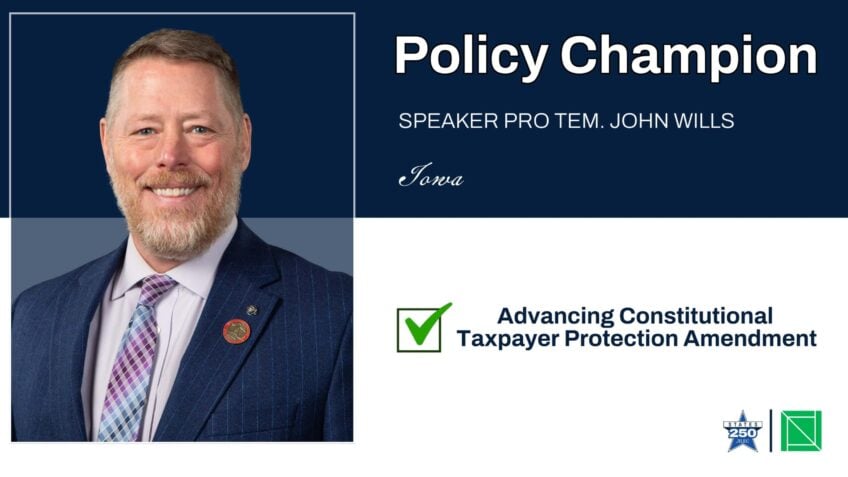
ALEC Policy Champion Advances Constitutional Taxpayer Protection Amendment in Iowa
Congratulations to Speaker Pro Tempore John Wills for taking a step towards a fiscally responsible Iowa.
ALEC is proud to recognize Speaker Pro Tempore John Wills as an ALEC Policy Champion for his leadership in advancing Senate Joint Resolution 11 in Iowa, a constitutional amendment on the November ballot that would require a two-thirds legislative vote to raise income tax rates or establish new income taxes.
Originally championed in the Senate by the late Sen. Rocky De Witt, this measure would create a new section in the Iowa Constitution, titled Article XIII (Taxation Limitations), if passed. In spring 2025, Sen. De Witt wrote:
Yesterday, I had one of the most rewarding opportunities of my career in the legislature: I floor managed the debating and closing remarks of SJR 11, an amendment to the Iowa Constitution. If passed, this measure would ultimately require a two thirds majority vote to increase any new individual income tax rates in the future, as opposed to a simple majority vote. This means that income tax rate increases on future Iowans will be much more difficult, a position I’m honored to take in defense of hardworking Iowans.
As he noted, the new section of the Iowa Constitution would require any bill that increases the individual or corporate income tax rate, raises the rate of any other income-based tax, or establishes a new tax on any type of income to have the votes of at least two-thirds of the members elected to each chamber. This would ensure that future legislators can only raise income taxes with a broad consensus from the legislature.
This proposed amendment follows the ALEC Principles of Taxation, which promote tax systems that are transparent, neutral, and reliable. These principles provide certainty for individuals and businesses as they plan where they should move next. This measure also aligns with the ALEC model policy, Super-Majority Act, which emphasizes that raising taxes should require broad consensus among legislators, ensuring more predictable burdens for taxpayers while prioritizing limited government and fiscal responsibility.
Leaders in the Hawkeye State have made strides to increase economic competitiveness in recent years. The state was one of five that passed legislation to switch to a flat tax in 2021—leading to the 3.8% flat tax that took effect there in 2025. A constitutional amendment to help receive a supermajority vote is one of the most consequential levers state policymakers can control in the race for business, capital, and workers. North Carolina will also face a referendum this November to decide on an income tax rate cap this November, reflecting the broad trend that states are leaning towards letting taxpayers keep more of what they earn.
Congratulations to Speaker Pro Tempore John Wills for taking a step towards a fiscally responsible Iowa.