


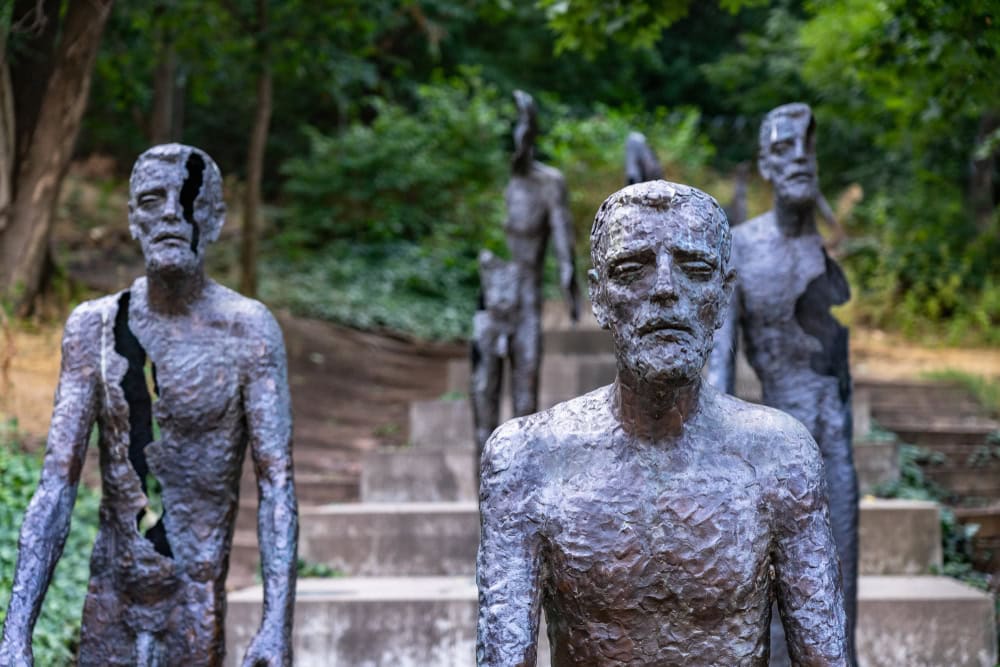
Nov. 7 is Victims of Communism Memorial Day, a time to reflect on the past and present horrors of communism and to honor its victims, estimated at 100 million lost lives. On that day in 1917, the Bolsheviks stormed the Winter Palace in Petrograd, Russia, toppling the provisional government that had ousted the Czar earlier in the year. This marked the end of the October Revolution and the beginning of the Union of Soviet Socialist Republics (USSR). Communism spread rapidly through countries bordering Russia, which were often annexed by the Kremlin as Soviet Republics equivalent to provinces or states. After World War II, due in part to the failure to rein in Stalin’s ambitions at Yalta, Soviet influence metastasized to engulf most of Eastern Europe. Soviet puppet governments were installed in Poland, East Germany, and Czechoslovakia, among others.
In China, Mao Zedong’s socialist revolution added the People’s Republic of China (PRC) to the growing list of communist countries that would eventually include PRC border states like North Korea, Vietnam, and Laos. During the Cold War in the Americas, several Central and South American countries installed communist governments, with Cuba and Venezuela still considered communist today.
Communism as an economic system led to widespread corruption, shortages of consumer goods and housing, and stultifying economic contraction and stagnation. Thirty-seven years after the fall of the Berlin Wall, many former Eastern Bloc countries are still playing economic catch-up. Thirty-six years post-reunification, Germans in the former East Germany only have half as much wealth as their western countrymen.
Communist economic mismanagement was devastating; however, communist oppression and the suspension of even modest liberty were catastrophic and often deadly. Communist dictators regarded all as potential enemies of the state, imprisoning and sometimes executing people following sham trials. Moscow especially targeted the well-educated, political leaders, and military general officers. The government suspended freedoms, instituted censorship, and restricted overseas travel and communication with foreigners.
The USSR’s “Russification” policies sought to replace native cultural practices and language in non-Russian republics with Russian ones. Russification fractured communities, prohibited languages other than Russian, and forced deportations to Siberia, leading to deaths and dislocation. An omnipresent surveillance apparatus helped the Kremlin keep tabs on its citizens.
The Holodomor, a Soviet-engineered famine in the 1930s that resulted in millions of Ukrainian deaths, began as a Stalinist farm collectivization program and ended with some Ukrainians forcibly removed to other republics and others left to starve as food ran out in the Republic of Ukraine. The Soviet government refused international aid, and Ukraine’s borders were sealed, preventing Ukrainians from seeking food elsewhere.
The Great Leap Forward was the Chinese Communist Party’s attempt at agricultural collectivization in the late 1950s and early 1960s. Conservative estimates are that 23-40 million Chinese perished in what has been described as the worst famine in modern history. Five years later, Mao launched the Great Proletarian Cultural Revolution (1966-1976) to eliminate his enemies and the “four olds” – Old Ideas, Old Culture, Old Customs, and Old Habits. The Red Guard, marauding gangs of communist party youths, helped enforce the Revolution’s policies. Victims suffered public humiliation, beatings, imprisonment, including at labor camps, and executions. The CCP conceded that the Cultural Revolution set the PRC back more than any event in its history.
Some communist countries no longer describe themselves as “communist”, “socialist”, or “people’s republics” and have added elements of synthetic capitalism to their economic frameworks. Semantics aside, these regimes are still domestically autocratic, and their foreign policies prioritize the subjugation of their neighbors – just like communist dictatorships. Russia routinely interferes in Moldova’s, Belarus’ and Georgia’s elections, detailed in ALEC articles here, here and here, and has prosecuted the war against Ukraine, a sovereign nation, with uncommon brutality. Most experts consider the abduction of Ukrainian children, which echoes Soviet Russification, a genocide.
The PRC has constructed a terrifying surveillance state, and PRC oppression of its Tibetan and Uyghur minorities has also been characterized as a genocide. The PRC threatens surrounding countries, annexed Hong Kong, as described in this ALEC article, and frequently pledges to “reunify” Taiwan, which it considers a renegade province. Many of communism’s most troubling excesses continue unabated.
ALEC members adopted the Victims of Communism Memorial Day Resolution almost a decade ago to memorialize the victims, past and present. This model policy establishes November 7 as an annual Victims of Communism Memorial Day, encouraging discussions and the distribution of learning materials to expose the brutal reality of communist regimes.
Another way to honor victims of communism is to prevent future victims through educational programs that help people understand the horrors of communism and other oppressive forms of governance. ALEC members passed the American Civics and History Act, which requires students to master U.S. civics principles and provides for instruction on a “comparative and objective analysis of ideologies throughout American and world history, including but not limited to capitalism, republicanism, democracy, socialism, communism, totalitarianism, and fascism.
Integrating willing countries into Western institutions offers them a lifeline to defend against communist countries seeking to oppress them. The ALEC Resolution in Support of Deepening Euro-Atlantic Integration of the Republic of Moldova seeks to help Moldova avoid communist capture, and ALEC has a library of model policies such as the Resolution Supporting Peace and Stability across the Taiwan Strait and Reaffirming the Importance of the Taiwan Relations Act and the Six Assurances and the Resolution to Oppose the People’s Republic of China’s (PRC’s) Misuse of United Nations Resolution 2758 to Delegitimize Taiwan and Exclude Taiwan from International Organizations – both meant to strengthen the US-Taiwan partnership and Taiwan’s global standing to deter PRC aggression. We can’t undo the past; however, we can act to address current atrocities and prevent future ones, and ALEC model policies provide a roadmap.