
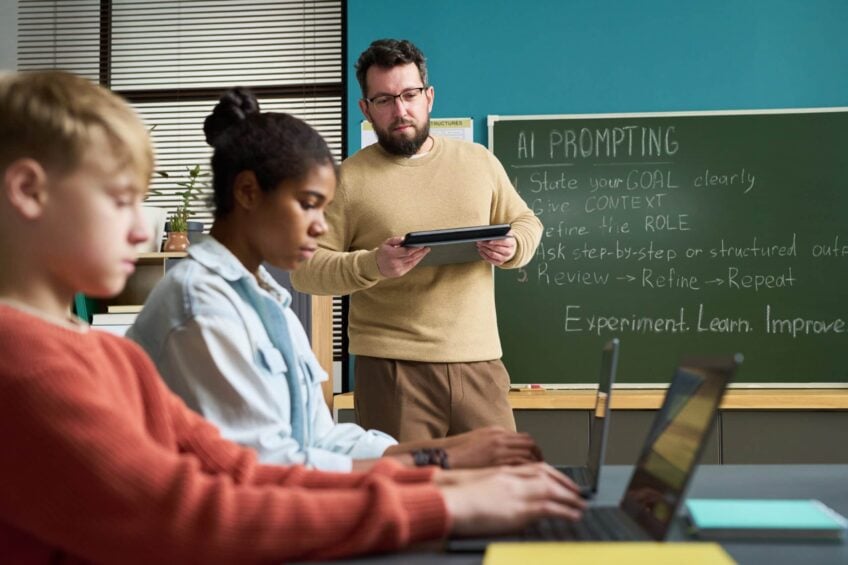
The Opportunities and Risks of AI in Education: Jake Morabito Conversation with Cato Institute
What impact can the right policies have on students, educators, and parents?
ALEC Senior Director of Policy Jake Morabito was recently featured as a guest speaker at a policy forum focused on artificial intelligence in education hosted by the Cato Institute.
Morabito was joined on the panel by Colleen Hroncich (Policy Analyst at the Cato Institute’s Center for Educational Freedom), Jennifer Huddleston (Senior Fellow in Technology Policy at the Cato Institute), Jennifer Wolverton (Founder of MARS Microschool), Shelby Doyle (Senior Vice President of Policy and National Partnerships at the National School Choice Awareness Foundation), and Jake Tawney (Director of Curriculum and Academic Resources at the Institute for Catholic Liberal Education).
Throughout the discussion, Morabito cautioned that over 40 states have already taken steps in recent years to regulate technology in the classroom. Instead of promoting blanket bans on all educational technology, policymakers should consider targeted solutions such as the ALEC model policy Limiting Student Use of Cell Phones in K-12 Classrooms that address a specific concern—in this case, classroom distractions from student personal devices.
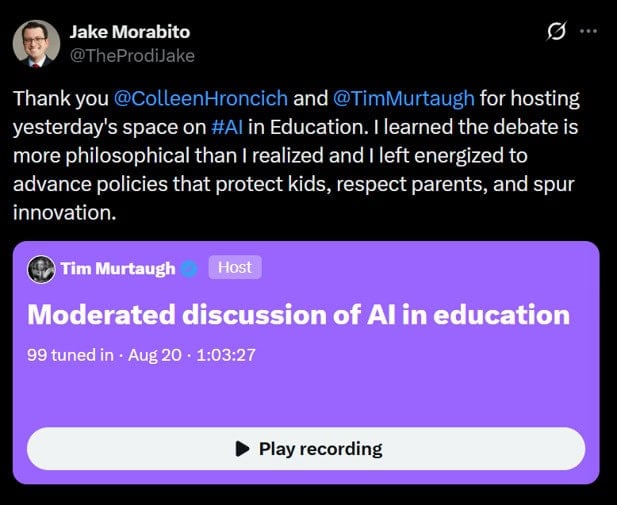
You can listen to the event recording in its entirety on X. See below for some highlights from his remarks:
On the State Legislative Landscape:
“To answer the question about the threat of regulation – I hate to be the one to inform you, but we’re already there, especially at the state level. States are not waiting around for Congress to deliberate on a national AI law. I do agree that a national AI strategy and common interstate rules that allow for innovation are needed.”
“I do think there’s a clear lane and role for states, especially K-12 education, which would be one of those that, again, is clearly in the lane of state government […] I think it would be a mistake for a national AI bill to usurp power from the states and communities in those state spaces.
“You do have over 40 states by now—I think almost 45 states—that either limited or prohibited the use of personal cell phones in schools. And I think a lot of that momentum will carry over to artificial intelligence chatbots. A big theme in the 2026 sessions was the use of AI for companion chatbots, and again, a lot of that had to do with children and some unfortunate use cases of these chatbots.”
On the Reaction to Social Media, Smartphones, and Technology in K-12 Classrooms:
“From the state legislative angle, I want to mention the need for intentionality in how AI systems are deployed in the education space. You’ve been seeing, especially more focused on social media and smartphones, somewhat of a reckoning or a second-guessing of technology in the classroom.
“I am supportive as far as getting personal devices out of the classroom and reducing distractions, but I think it could be easy to get all educational technology caught up in that conversation […] If you don’t get parents on board and have an intentional rollout of these tools, I think that could rub some people the wrong way.
On the Role of Parents and Caregivers in Child Online Safety:
“I love the point about responsible use, especially starting in the home and also keeping it age-appropriate.
“I know, just anecdotally and from what I’ve read about the K-12 environment right now, that some of the parents are fatigued or overwhelmed with the current integration of technology. We need to rebuild a lot of that trust and demonstrate the vision.”
On the Positive Examples of AI in the Classroom:
“We’re still figuring out some of those cultural norms and mores when it comes to AI in education.”
“If you’re using it ethically or responsibly, it’s supposed to help you understand the text, or, you know, get through the text better, and not supplant your reading of it entirely […] Someone was able to use an AI bot to essentially coach them through it, you know, essentially read through the text. And if they were misunderstanding a part, they could consult with the chatbot to make sure they were understanding it correctly, or if they had questions about some of the elements, they could ask the bot. But they were engaging with it in good faith. In other words, they weren’t using it to complete the assignment for them […] That person may not have finished the book, and I would think they’d be better for it now that they’ve completed the text and might be empowered or motivated to read more.
“Especially as we get higher along, I love that idea about children working with virtual twins or in digital environments and building apps. I think we need all of that to build the digital workforce of the future.”