


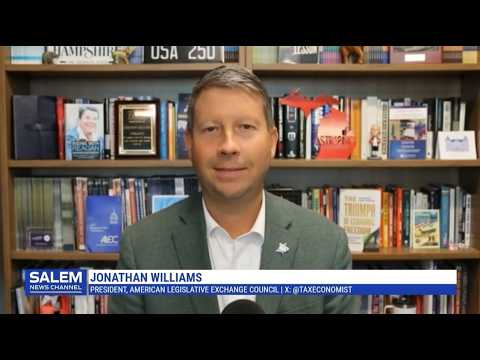
Hugh Hewitt spoke with ALEC President and Chief Economist Jonathan Williams about ballot measure results in the midterms and the impact on state competitiveness.
The conversation began with North Carolina and its ballot measure successes, including capping its flat income tax, providing property tax relief, and implementing election integrity requirements.
Williams argued that the results demonstrated that voters continue to favor limited-government policies, regardless of how they vote in candidate races.
“North Carolina realizes it’s been successful for so many years because it’s followed the ALEC limited government principles, and those voters were not going to give up on those principles.”
Hewitt then turned to California, where voters rejected a proposed billionaires’ tax. Williams called the outcome a victory for economic common sense, arguing that the measure could have accelerated the departure of wealthy residents and businesses from the state.
“We did have good news in that they did see through this horrible idea that would have accelerated the outmigration even further,” Williams said.
The conversation shifted to Iowa, where voters approved a legislative supermajority requirement to raise income taxes. Williams praised the measure, noting that Iowa has become a leader in reducing taxes and lowering the cost of living under Governor Kim Reynolds.
“Voters said we want to make it more difficult for future legislators to raise our income taxes,” he explained.
Williams then addressed Colorado, where voters agreed to pause provisions of the state’s Taxpayer’s Bill of Rights (TABOR). Enacted in 1992, the provision was designed to limit government spending growth to population growth plus inflation.
Williams warned that weakening the measure could undermine one of Colorado’s most important fiscal safeguards.
“That’s been the one thing that’s kept Colorado from becoming California was this limit on government growth that’s not going to be there for the next number of years,” he said.
Hewitt also asked about Washington state, where voters rejected an effort to repeal a newly enacted personal income tax approaching 10 percent. Williams predicted the change would hurt the state’s economic competitiveness and push it toward the bottom of ALEC’s annual economic outlook rankings.
“The no income tax status was one of the reasons Washington state always was a growth magnet,” he said. “I’m really afraid for the future of Washington state after the vote this week.”
The discussion concluded with Williams identifying Arizona as another state to watch, warning that its new governing majority could threaten successful policy wins in the state.
“They’re going to have a first liberal trifecta of state government for over 50 or 60 years, and there’s going to be some big efforts, unfortunately, to try to overturn that education freedom and their 2.5% flat tax,” he highlighted.
Despite the setbacks, Williams remained optimistic about ALEC’s ability to promote conservative policy solutions across party lines.
“Some of our friends have reiterated how important ALEC will be to galvanize common sense ideas,” he emphasized.