
New ALEC Letter to Support Taiwan’s Freedom
Now is the time to amplify the voice of the states and send a clear message to Washington and to the world. Delegitimization of Taiwan will no longer be tolerated.
The ALEC Center for International Freedom has just launched a new letter. This letter urges the President of the United States to call on the United Nations (UN) to oppose the People’s Republic of China’s (PRC’s) misuse of United Nations General Assembly (UNGA) Resolution 2758 and to stop invoking UNGA 2758 to deny Taiwan’s participation in UN institutions.
The PRC has increasingly weaponized UNGA Resolution 2758 against Taiwan, a distortion that has real-world consequences most notably excluding Taiwan from participating fully in critical international bodies like the International Civil Aviation Organization (ICAO) and Interpol which denies us all the benefit of Taiwan’s input and expertise.
However, UNGA 2758’s distortion also delegitimizes Taiwan, a country in the geographical center of the first island chain which is crucial to U.S. force projection in the Asia-Pacific and that is a vital U.S. economic partner – especially in the fields of artificial intelligence (AI) and semiconductors. Signing this letter is an important way to demonstrate your support for Taiwan.
ALEC adopted model policy to support the concepts outlined in this letter, and former ALEC National Chair, WV State Senator Patricia Rucker along with WV Delegate William Ridenour were honored as ALEC Policy Champions for their leadership on legislation that condemned the PRC’s misuse of the UN Resolution.
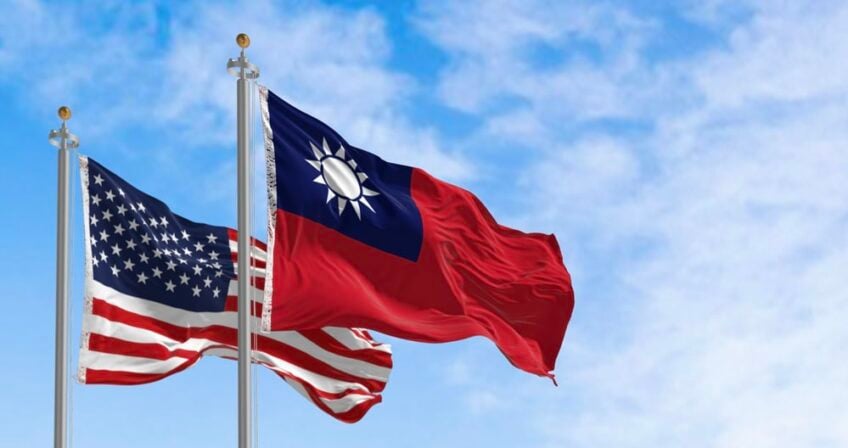
One of the outrages facilitated by UNGA 2758 is that Taiwan’s flag cannot be displayed and national anthem cannot be played for Taiwanese athletes taking home the gold – read more about that here. The U.S. hosts Olympic games in 2028 and 2034, where America can correct this wrong.
Now is the time to amplify the voice of the states and send a clear message to Washington and to the world. Delegitimization of Taiwan will no longer be tolerated.
President Donald J. Trump
The White House
1600 Pennsylvania Avenue, NW
Washington, DC 20500
Dear Mr. President:
We, the undersigned legislators, in partnership with the ALEC Center for International Freedom, urge you to call on the United Nations to oppose the misuse of United Nations General Assembly (UNGA) Resolution 2758 by the People’s Republic of China (PRC) and to stop invoking the Resolution to deny Taiwan’s participation in United Nations (UN) institutions. Additionally, we encourage you to call on the United Nations Secretariat to remain neutral and to refrain from citing UNGA Resolution 2758 to prevent Taiwanese nationals and news media from visiting UN buildings or attending or covering UN conferences and events. UNGA 2758’s original purpose and meaning have been misrepresented by the PRC to block Taiwan’s participation in international institutions and to delegitimize the Republic of China (Taiwan) as a sovereign state globally.
Adopted by the United Nations General Assembly (UNGA) in October 1971, the PRC has increasingly weaponized UNGA Resolution 2758 against Taiwan. The ROC, also known as Taiwan, was one of the 51 original member states of the UN until the adoption of Resolution 2758, which only recognized that the representatives of the Government of the PRC are the only lawful representatives of China to the United Nations. Shifting representative status to the PRC was never intended to settle the matter of the so-called “One China Principle” (OCP), although the PRC has wrongfully conflated UNGA 2758 with the OCP. Most alarmingly, the PRC is using UNGA 2758 to assert that Taiwan is an “inalienable part of China,” thereby attempting to create a legal pretext for future aggression in contravention of the UN Charter’s ban on the use of force.
The distortion of UNGA 2758 has real-world consequences. UNGA 2758 is misused to bar Taiwan from participating fully in critical international bodies, including the International Criminal Police Organization (INTERPOL), the World Health Organization (WHO), the United Nations Framework Convention on Climate Change (UNFCCC), and the International Civil Aviation Organization (ICAO). Taiwan’s exclusion from INTERPOL deprives the organization of vital input for geopolitical reasons, violating its own “vision” of “a world where law enforcement can securely access, share, and communicate vital policy information whenever and wherever needed, thereby supporting the security of the world’s citizens”. Taiwan has a strong willingness and ability to contribute to fighting transnational crime, including cybercrime, for which it is ideally suited given its robust information, communications, and technology (ICT) sector. Excluding Taiwan from the WHO prevents Taipei from efficiently sharing best practices globally. Given Taiwan’s exemplary handling of the COVID-19 pandemic, Taiwan’s contributions in the health space are particularly valuable. Aviation safety is a universal issue that requires participation by all global stakeholders, and Taiwan’s exclusion is particularly risky since the Taipei Flight Information Region (FIR) is among the busiest in the world.
As a sovereign country with a population of more than 23.5 million located in one of the globe’s fastest growing regions with a dynamic economy that leads in the manufacturing of many of the technologies underpinning 21st century innovation, Taiwan’s participation in these international organizations would enhance their work. However, Taiwan’s efforts for membership and even participation are routinely obstructed by the PRC.
PRC weaponization of UNGA 2758 also carries strategic consequences for the United States. Taiwan is in the center of the first island chain, a strategically significant string of islands that stretches from Japan to the Philippines and Indonesia. The first island chain is vital to US force projection in the Asia-Pacific and serves as a deterrent to PRC aggression. Additionally, the U.S. and Taiwan share a mutually beneficial economic partnership, especially in the fields of artificial intelligence (AI) and semiconductors. America’s innovation capabilities, combined with Taiwan’s advanced manufacturing expertise, strengthen and advance U.S. leadership in the global AI sector. A loss of Taiwanese self-determination would negatively affect America’s international supply chains and national security. We, the undersigned lawmakers, support the U.S. government in continuing to uphold its security commitments to Taiwan in accordance with the Taiwan Relations Act and the Six Assurances. The United States’ firm support for Taiwan’s meaningful participation in international organizations reflects its consistent and long-standing position. We likewise back continued U.S. actions to support Taiwan and counter China’s legal warfare tactics, which have become more brazen with time, including coercing countries to deny overflight permission for an aircraft transporting Taiwan’s President Lai to Eswatini on an official visit this spring.
Finally, Taiwan is recognized as a beacon of democracy in the Asia-Pacific, a distinction that gives hope to nascent democracies. Taiwan’s full inclusion in the world community would help to strengthen the resolve of other nations in the region to emulate this vibrant, open, and economically successful country.
ALEC has long supported Taiwan’s right to self-determination, and ALEC members have adopted model policies aimed at strengthening the US-Taiwan partnership for more than 16 years. It is time for the United Nations to acknowledge Taiwan’s legitimacy and to cease misusing UNGA 2758 to undermine Taiwan on the world stage.
Cc: The Honorable Marco Rubio
The Honorable Mike Waltz
The Honorable James E. Risch, Chairman US Senate Foreign Relations Committee
The Honorable Jeanne Shaheen, Ranking Member US Senate Foreign Relations Committee
The Honorable Brian J. Mast, Chairman US House Foreign Affairs Committee
The Honorable Gregory W. Meeks, Ranking Member US House Foreign Affairs Committee