
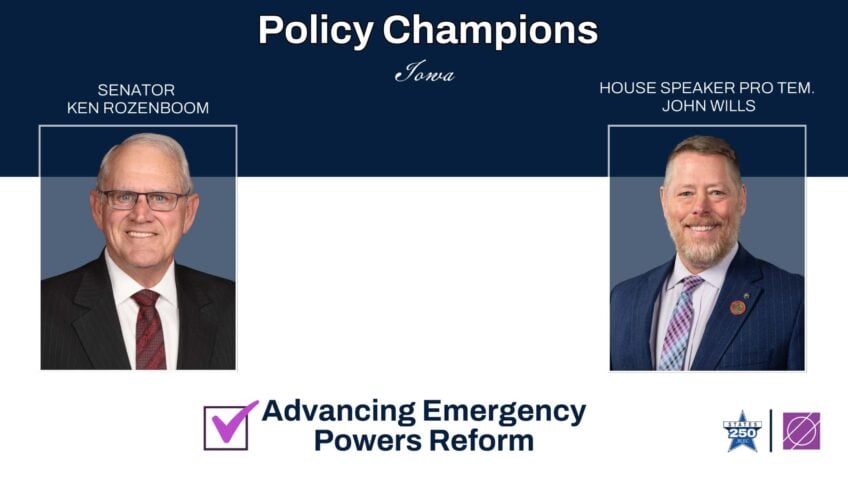
ALEC Policy Champions Advance Emergency Powers Reform in Iowa
ALEC proudly recognizes Iowa House Speaker Pro Tempore John Wills and Sen. Ken Rozenboom as ALEC Policy Champions for their leadership in advancing this important reform.
Iowa has taken a significant step toward reinforcing the separation of powers and protecting individual liberties by enacting HF 2694. Signed into law by Gov. Kim Reynolds on June 2, this legislation places meaningful limits on the exercise of executive authority during declared states of disaster emergency and strengthens legislative oversight of emergency powers. ALEC proudly recognizes Iowa Sen. Ken Rozenboom and House Speaker Pro Tempore, and ALEC Board Member, John Wills as ALEC Policy Champions for their leadership in advancing this important reform.
These reforms closely align with the principles embodied in ALEC’s Emergency Power Limitation Act—a featured model policy in ALEC’s Essential Policy Solutions for 2026—which seeks to preserve constitutional checks and balances during emergencies while ensuring that fundamental rights remain protected. By restoring a greater role for the legislative branch in emergency governance, Iowa has reinforced the principle that extraordinary powers should remain limited and subject to meaningful democratic oversight.
HF 2694 establishes clear safeguards against the concentration of authority in a single executive office during times of crisis. The law prohibits the governor from closing or otherwise restricting places and practices of worship through a disaster emergency proclamation and prevents emergency measures from regulating conduct within private residences. Additionally, the legislation bars emergency actions from altering election laws, policies, or regulations without prior approval from the General Assembly or imposing vaccination mandates.
The measure also places important limits on executive authority over private enterprise. During a public health disaster, state officials may recommend—but not require—that private businesses cease lawful operations. Furthermore, a declared state of disaster emergency will terminate after thirty days unless renewed, while the General Assembly retains the authority to rescind an emergency declaration.
The enactment of HF 2694 reflects a growing recognition among policymakers that emergency powers, while necessary in limited circumstances, must be carefully constrained to prevent executive overreach. Declared states of emergency often represent the moment when executive authority is at its highest authority that is frequently unlocked through the unilateral declaration of executive heads themselves. By establishing clear boundaries around that authority, Iowa has strengthened protections for religious liberty, private property rights, economic freedom, individual health choices, and the constitutional role of the legislature.
Rep. Wills’ and Sen. Rozenboom’s efforts helped secure meaningful protections for Iowans while reaffirming the importance of maintaining constitutional governance during times of crisis. ALEC also commends Gov. Kim Reynolds for enacting the legislation and helping ensure that emergency powers remain tempered and regulated by the people’s and elected representatives.
This reform marks an important achievement for responsible government in Iowa and reflects continued momentum among states seeking to restore the proper balance of power between the branches of government. Congratulations to Iowa on this significant accomplishment.