
Introduction
John Ream, an Ohio resident who wants to distill spirits at home for personal use, challenged the federal prohibition on home distilling, arguing that Congress lacks constitutional authority to prohibit this purely local, noncommercial activity. The Sixth Circuit Court of Appeals rejected his challenge, holding that the prohibition is a valid exercise of Congress’s Necessary and Proper Clause authority in support of its taxing power—a decision that conflicts with the Fifth Circuit’s recent conclusion that the federal home-distilling ban exceeds Congress’s constitutional authority, creating a circuit split among the federal Courts of Appeals.
Ream also presents a direct challenge to the expansive conception of federal power established under Wickard v. Filburn (1942), which held that Congress could regulate even wheat grown for personal consumption because, considered in the aggregate, such activity could substantially affect interstate commerce. Ream asks whether the federal home-distilling prohibition exceeds Congress’s enumerated powers and whether the Court should overrule or limit Gonzales v. Raich (more recent precedent built on the Wickard foundational doctrine) —and, more fundamentally, restore meaningful limits to the Commerce Clause.
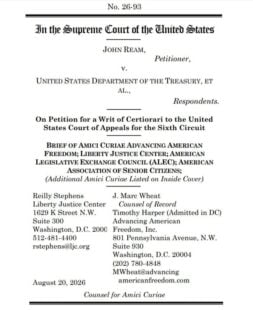
ALEC joined Advancing American Freedom’s amicus brief, arguing that the Taxing, Commerce, and Necessary and Proper Clauses cannot be used to give Congress a general police power over purely local activity.