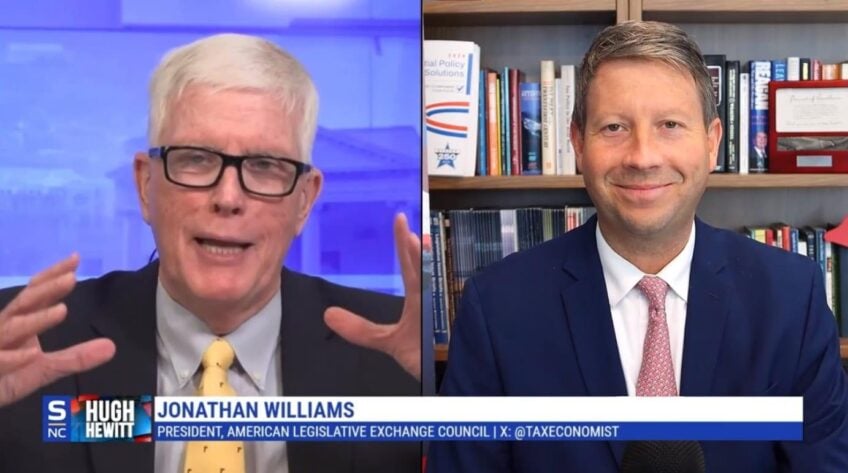
The Ohio vs. Michigan Rivalry in Rich States, Poor States: Jonathan Williams on The Hugh Hewitt Show
When you combine the good tax policies and common-sense regulatory policies with the education freedom side, that’s a combo that’s really difficult to beat.
The conversation opened with a familiar rivalry, as Hewitt asked Williams to compare Ohio and Michigan in this year’s rankings.
“I knew this is that you’ll be on cloud nine today,” Williams said. “It is really a tale of two states. This year is one of our key story lines, which is that the biggest improvement of any state came in Ohio, going from 25th to 15th, where Michigan was actually the state that lost the most ground this year, losing 13 spots and going down there below average.”
Williams attributed the contrast to policy differences, particularly on taxation and fiscal governance.
“You juxtapose the great flat tax at 2.75% on personal income there in Ohio, led by President McColley and so many of his great colleagues in the Ohio General Assembly, and what Michigan has done,” he explained. “If it wasn’t Speaker Matt Hall, Michigan would be in the bottom 10 right now, because of the Whitmer administration and the progressives in the Michigan Senate.”
He also emphasized the historical perspective embedded in the ALEC report.
“Ohio started at 47 for economic outlook in the first edition, and here you are now at an all-time best record of 15th, and I’m convinced you’re on your way to the top 10.”
Hewitt also raised North Carolina’s rapid ascent in the rankings, prompting Williams to highlight it as a model for reform.
“It’s a great turnaround story,” he said. “You had North Carolina middle of the pack, and here you are today with the fourth best economic outlook in America. The business tax rate at the end of this decade… zero. Talk about an economic development strategy.”
Williams concluded by underscoring the broader formula behind top-performing states.
“When you combine the good tax policies and common-sense regulatory policies with the education freedom side, that’s a combo that’s really difficult to beat.”