
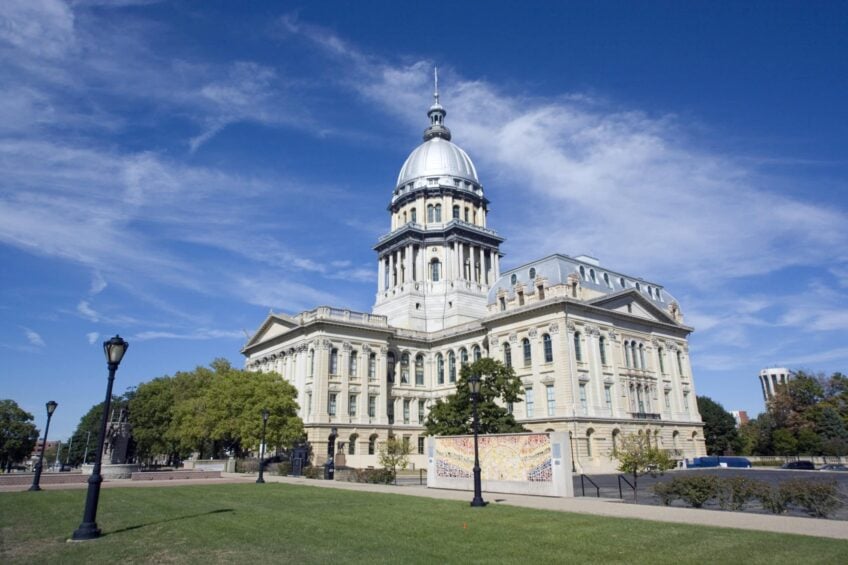
Illinois is Closed for Business: Alan Jernigan and Joshua Meyer in Center Square
Chicago was once the proud capital of the Midwest; today it is seeing an exodus of businesses to more competitive states.
ALEC Task Force Directors Alan Jernigan and Joshua Meyer co-authored an op-ed in The Center Square examining Illinois’ economic policy landscape and the state’s outlook in the 19th edition of Rich States, Poor States. Together, they discuss how current fiscal and regulatory policies are shaping Illinois’ economic competitiveness and long-term outlook.
The policies coming from Springfield send a clear message: Illinois is closed for business. While other states enact pro-growth policies and create economic opportunity, Illinois is weakening the market forces that once powered its growth. As a result, businesses and individuals are fleeing the state, further weakening economic conditions and pushing the state further towards a fiscal cliff.
The recently-released 19th edition of Rich States, Poor States, co-authored by native-Chicagoan Steve Moore, Dr. Arthur B. Laffer, and Jonathan Williams, ranks the Land of Lincoln 45th for economic outlook. Illinois has the eighth-highest corporate tax rate, sixth-highest property tax rate, and sixth-highest burden across all other minor taxes. Poor fiscal stewardship is reflected in it having the second-highest unfunded pension liabilities per capita and sixth-highest debt service costs. The prohibition on graduated income taxes in the state’s constitution is perhaps the only bright spot.
These policy choices have led residents to vote with their feet. Since 2016, more than 900,000 Illinoisans have left for one of the other 49 states. Their top destinations are Florida, Wisconsin, Texas, Indiana and Missouri.
One of the most destructive policy choices the state has made is its Interchange Fee Prohibition Act. Passed in 2024, the law prevents banks and payment networks from collecting interchange fees on the tax and tip portions of credit card transactions. It would require overhauling payment infrastructure never designed to separate transactions at that level, driving up compliance and implementation costs across the board.
Read the full opinion piece here.