

Redistricting in Virginia Ahead of the 2026 Elections
Virginia’s situation is particularly notable because its redistricting process is a hybrid system.
Virginia is moving full steam ahead in the redistricting fight. Although the state had already adopted new congressional and legislative maps following the 2020 census, political pressures, shifting partisan incentives, and procedural disputes pushed lawmakers to undertake an unprecedented attempt at mid‑decade redistricting. The result, a complex legal and political struggle that remains unresolved.
The effort began in October 2025, when the Virginia General Assembly adopted a resolution allowing lawmakers to consider a constitutional amendment authorizing mid‑decade redistricting. The House of Delegates and Senate both passed the measure. Under Virginia’s constitutional rules, amendments must pass in two consecutive legislative sessions, with an election in between, before going to voters for approval. Lawmakers reconvened in January 2026 and again passed the amendment, clearing the procedural hurdle needed to place the measure on the ballot.
Despite clearing the legislative threshold, the amendment quickly ran into legal trouble. On January 27, 2026, a state judge blocked the amendment from appearing on the ballot. The ruling held that the amendment had been improperly introduced during the 2025 special session because the session’s procedural rules required unanimous consent to add new items to the agenda. Since Republicans had opposed the amendment, the judge issued both preliminary and permanent injunctions preventing it from advancing. The decision was appealed, and the state court of appeals subsequently passed the case to the Virginia Supreme Court. The case has not been decided, leaving the future of the amendment and any new congressional map uncertain.
The stakes of the dispute were significant. Virginia’s existing congressional delegation stands at six Democrats and five Republicans, a relatively balanced split in a state that has leaned Democratic in recent statewide elections and saw a close margin for a Democratic victory in the 2024 presidential race. Democratic leaders believed a new map could shift multiple seats in their favor, potentially influencing control of the U.S. House of Representatives in 2026.
The proposed map, pictured below, would create a 10-1 Democrat majority. The map would divide the heavily populated Fairfax County, a northern suburban county just outside Washington, DC, into five congressional districts that reach down into the rural parts of the state. Opponents of the map believe this violates the “compact and continuous” standard required for district lines.
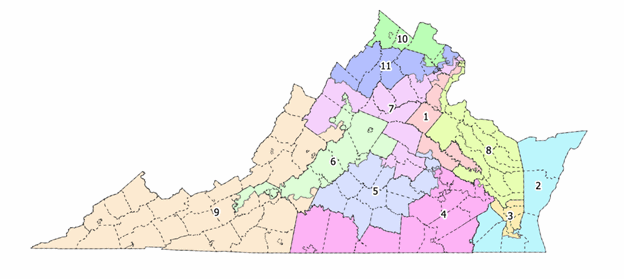
Virginia’s situation is particularly notable because its redistricting process is a hybrid system: a bipartisan commission draws maps, but if it deadlocks—as it did in 2021—the state supreme court steps in. The 2026 effort represented a legislative attempt to reclaim control from the commission‑court structure.
Virginia has not enacted a new congressional map yet. The fate of the amendment—and any subsequent redistricting—depends on the Virginia Supreme Court’s willingness to overturn the lower court’s procedural ruling. The Court announced that it will allow the amendment to remain on the ballot as they schedule oral arguments. This choice is a strong signal that the amendment will go ahead as planned. If the amendment passes, lawmakers could implement the new map before the 2026 elections. If not, the existing 2021 court‑drawn map would remain in place.