
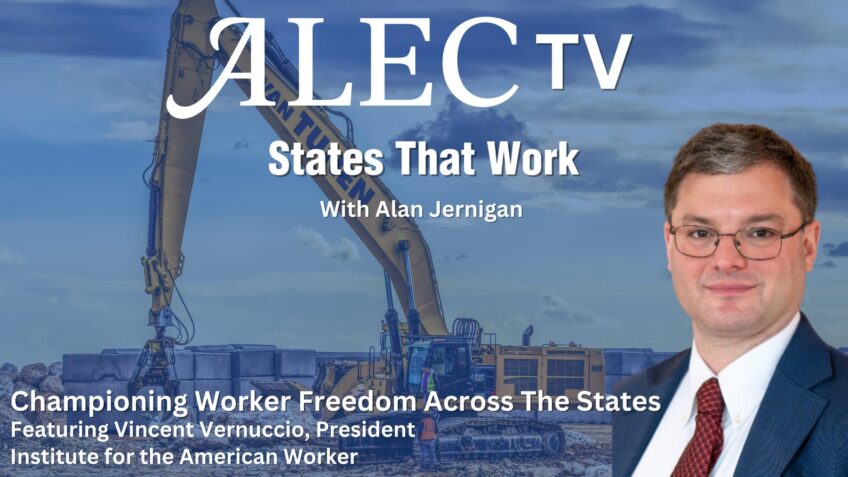
Championing Worker Freedom Across The States: Alan Jernigan and Vincent Vernuccio
They are a great guide for state lawmakers that want to better protect our workers.
As debates over worker rights ripple across the country, one message continues to echo from state to state: workers deserve the freedom to choose the work arrangements that fit their lives best. But how should lawmakers turn that principle into policy?
To help answer that, ALEC Commerce, Insurance, and Economic Development Task Force Manager Alan Jernigan and Institute for the American Worker President Vincent Vernuccio sat down on a recent ALEC TV Breakdown to spotlight the third edition of States That Work: A Labor Policy Roadmap Across America. The publication, they explained, is more than a report—it’s a call to action.
“This is the third edition of our labor publication,” Jernigan emphasized. “It tracks 10 key ALEC model policies across all 50 states.”
Among those policies, few are as widely debated—or misunderstood—as Right to Work laws. Vernuccio didn’t hold back in setting the record straight. “Right to Work means that a union can’t get a worker fired for not paying them,” he explained. “It doesn’t affect collective bargaining in any other way.”
But it’s not just about principle—it’s also about economic outcomes. “Right to Work states generally see higher population growth and higher wage growth—especially when factoring in cost of living,” Vernuccio said.
Unfortunately, not every state is leaning in that direction. Vernuccio pointed to Michigan’s repeal of its Right to Work law in 2012 as a stark example. “The most significant thing it’s going to do is deny freedom and the choice of workers to decide,” he warned.
The discussion then turned to ongoing legislative efforts in Georgia, Alabama, and Tennessee, where lawmakers are working to protect secret ballot elections in unionization efforts. “These laws ensure that if a company receives state incentives, workers get to vote by private ballot,” Vernuccio explained. “The alternative—card check—opens the door to intimidation and coercion.”
When asked if these reforms were anti-union, Vernuccio was clear: “These are pro-worker policies. They empower the individual worker—that’s who I fight for every day.”
The conversation also spotlighted a growing concern in the modern economy—freelance and gig workers. Jernigan and Vernuccio praised states like Utah and West Virginia for protecting the rights of independent contractors. “States can protect workers’ choice to remain independent and help them access portable benefits,” Vernuccio said, referencing the Modern Worker Empowerment Act as a possible federal solution.
As the segment wrapped, both speakers returned to the importance of States That Work as a practical tool for policymakers. “I love the model policies in there. They are a roadmap to worker freedom,” Vernuccio concluded. “They are a great guide for state lawmakers that want to better protect our workers.”