
ALEC Policy Champions Combat Antisemitism in Wisconsin
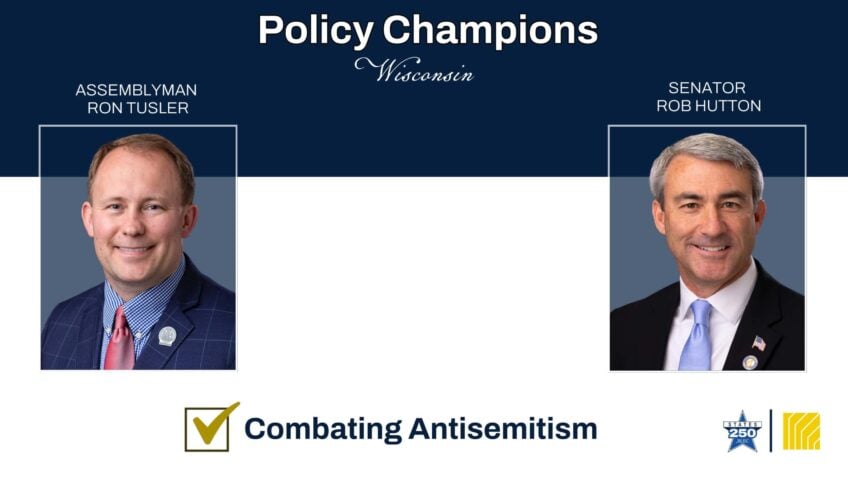
ALEC commends the sponsors of AB 446 and SB 445, Assemblyman Ron Tusler and Wisconsin Sen. Rob Hutton, for leading the charge to combat antisemitism.
We are proud to congratulate ALEC’s newest Policy Champions: Wisconsin Assemblyman Ron Tusler and Wisconsin Sen. Rob Hutton, sponsors of AB 446 and SB 445. This legislation adopts the International Holocaust Remembrance Alliance (IHRA) Working Definition of Antisemitism and is consistent with ALEC model policy featured in Essential Policy Solutions for 2026.
In late March, Wisconsin Gov. Tony Evers signed Wisconsin Act 143 into law. Wisconsin now joins 37 other states that have adopted the IHRA definition, strengthening protections for their Jewish residents and defining what antisemitism is and what it is not, striking the appropriate balance between protecting their citizens while upholding free speech principles.
The Wisconsin legislation requires state officials to consider the IHRA Working Definition of Antisemitism when “evaluating evidence of discriminatory intent” and assigning penalties when faced with possible discrimination based on race, religion, color, or national origin.
Released by the IHRA – an alliance of 35 member countries, including the United States – on May 26, 2016, the IHRA Working Definition of Antisemitism is unique in that it provides 11 modern illustrations to describe antisemitism. Examples include “Calling for, aiding, or justifying the killing or harming of Jews in the name of a radical ideology or an extremist view of religion” and “Holding Jews collectively responsible for actions of the state of Israel.”
Wisconsin’s new law should be a wake-up call to those states that have yet to adopt the IHRA Working Definition of Antisemitism, that antisemitic actions against their citizens must be taken seriously. Since Hamas attacked Israel on Oct. 7, 2023, acts of domestic antisemitism have increased dramatically. Although Jews make up only 2.4% of the US adult population, according to the Federal Bureau of Investigation (FBI), nearly 70% of religion-based hate crimes in 2024 were perpetrated against Jews – marking the largest increase since the FBI began keeping records on antisemitism.
Wisconsin has seen a 500% uptick in reports of antisemitic incidents over the last ten years; not surprisingly, the Milwaukee Jewish Federation applauded the passage of AB 446 and SB 445.
Antisemitic assaults continued to climb in 2025, including the murders in Washington, DC, of two Israeli embassy officials and the firebombing of demonstrators in Boulder, CO, who were calling on Hamas to release the hostages held in Gaza.
The recent resurgence of the world’s oldest hatred is not a domestic phenomenon but a global one. Last month in north London, two Jewish charity-owned ambulances were torched outside a synagogue, and in December at Bondi Beach in Australia, two gunmen killed 16 people at a public Chanukah celebration. The alarming spike in antisemitic attacks motivated ALEC members to adopt the model Act to Adopt the International Holocaust Remembrance Alliance (IHRA) Working Definition of Anti-Semitism in 2024.
We also congratulate the bipartisan and dedicated co-sponsors: State Assembly Members Alex Dallman, Barbara Dittrich, Bob Donovan, Jodi Emerson, Rick Gundrum, Nate Gustafson, Dan Knodl, Rob Kreibich, Dave Murphy, Jerry O’Connor, Sylvia Ortiz-Velez, Lisa Subeck, and Chuck Wichgers, as well as State Sens. Rachael Cabral-Guevara, Dianne Hesselbein, Jesse James, Brad Pfaff, Patrick Testin, Jamie Wall, Van Wanggaard, and Bob Wirch.
Wisconsin Act 143 is a stirring example of lawmakers on both sides of the aisle who recognized that upholding civil rights is a universal principle and worked together to forge a solution to enhance the safety of their states’ residents.
ALEC commends the sponsors of AB 446 and SB 445, Assemblyman Ron Tusler and Wisconsin Sen. Rob Hutton, for leading the charge to combat antisemitism. These lawmakers worked together to prioritize vulnerable Wisconsin residents over political partisanship, and because of them, their state’s Jewish residents may be a little safer.