
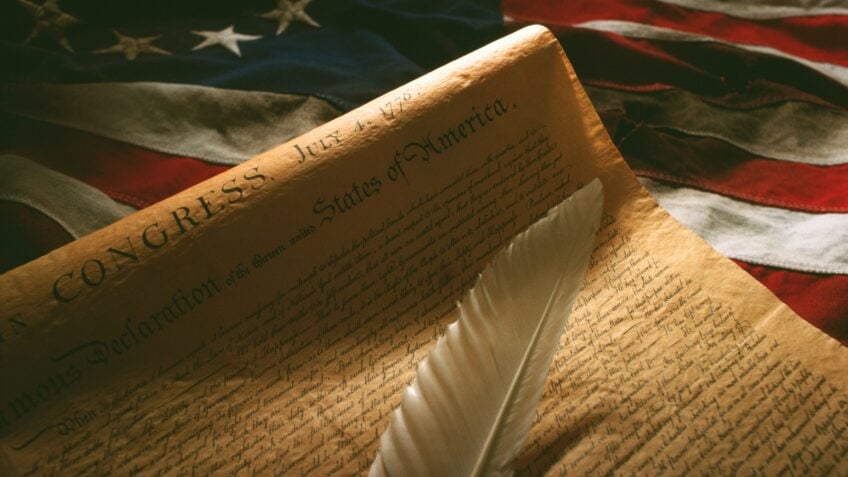
The Founders’ Inspiration for a Nation: Civilian Oversight in Military Power
Today, civilian control over the military is firmly established in our constitutional system.
The colonists believed King George III was weakening the important idea that the military should remain under civilian authority. They viewed civilian control of the military as an essential protection for their rights and freedoms. These next grievances in the Declaration of Independence address the relationship between the military and government.
Grievance 12 reads, “He has affected to render the Military independent of and superior to the Civil Power.”
Civilian control over the military is a concept deeply embedded in classical republican political thought, where it serves as a safeguard against the tyranny historically associated with standing armies. While England embraced this philosophy internally by placing the king and Parliament over the British military, colonists believed the king violated it in the colonies by appointing General Thomas Gage as Massachusetts governor. This appointment made Gage simultaneously the British commanding general for North America and the king’s chief civil authority in Massachusetts.
Today, civilian control over the military is firmly established in our constitutional system. The people’s representatives in Congress retain the power to declare war, fund the military, and create legal rules that govern the military’s use. At the same time, the President serves as Commander in Chief of the Armed Forces, which ensures that the head of the military is politically accountable. This division of authority provides checks and balances while ensuring military subordination to civil authority.
Grievance 13 reads, “He has combined with others to subject us to a jurisdiction foreign to our constitution, and unacknowledged by our laws; giving his Assent to their Acts of pretended Legislation.”
The colonists bristled at their laws being superseded by a “foreign” parliament an ocean away, with their frustration evident in this passage.
These new Americans constructively channeled their outrage into developing a governing framework intended to be impervious to tyranny. The U.S. Constitution gives the federal government only limited and enumerated powers and assigns all other authority to the states and localities, effectively devolving much power to government closest to the governed. Our Founders created a federal republic with federalism serving as a bulwark against federal overreach. In Bond v. United States, the Supreme Court observed that “…federalism secures to citizens the liberties that derive from the diffusion of sovereign power.” Federalism was designed to prevent “a jurisdiction foreign to our constitution” from subjecting Americans to “unacknowledged” laws – including those promulgated by our own national government.
Grievance 14 reads, “For Quartering large bodies of armed troops among us.”
The practice of quartering soldiers dates back to the Roman Republic, when territorial governors imposed it on local populations as both a tool of oppression and a source of revenue. This practice emerged in the American colonies when the British Parliament passed the Quartering Act of 1765 and required American colonists to provide housing, food, and supplies for British troops stationed in their towns. Since tensions were already high between the colonists and the British troops, the colonists interpreted this law as requiring them to pay for their own oppression.
After the American Revolution, Delaware, Maryland, Massachusetts, and New Hampshire adopted laws to restrict quartering. On the federal side, the original Constitution draft did not include any similar provisions, so Virginia, New York, and North Carolina proposed amendments to prohibit involuntary peacetime quartering and restrict wartime quartering to specified limits. This formed the basis of the Third Amendment: “No Soldier shall, in time of peace, be quartered in any house, without the consent of the Owner, nor in time of war, but in a manner to be prescribed by law.”
Grievance 15 reads, “For protecting them, by a mock Trial, from punishment for any Murders which they should commit on the Inhabitants of these States.”
As tensions rose in the colonies, violence would occasionally break out between colonists and British troops. In 1768, for example, British soldiers killed two residents of Annapolis, Maryland. Despite overwhelming evidence against them, the soldiers were acquitted when the case went to trial. Six years later, Parliament passed the Administration of Justice Act. The law required British soldiers accused of murder to be tried in Britain rather than in the colony where the crime occurred.
These perceived injustices led the Constitution’s Framers to include safeguards, ensuring fair criminal trials. Article III, Section 2 states: “The Trial of all Crimes, except in Cases of Impeachment, shall be by Jury; and such Trial shall be held in the State where the said Crimes shall have been committed; but when not committed within any State, the Trial shall be at such Place or Places as the Congress may by Law have directed.” This idea is also found in the Sixth Amendment: “In all criminal prosecutions, the accused shall enjoy the right to a speedy and public trial, by an impartial jury of the State and district wherein the crime shall have been committed, which district shall have been previously ascertained by law, and to be informed of the nature and cause of the accusation; to be confronted with the witnesses against him; to have compulsory process for obtaining witnesses in his favor, and to have the Assistance of Counsel for his defense.”
These experiences shaped the American commitment to keeping the armed forces under clear civilian leadership. The Constitution gives Congress, as the people’s representative body, the power to raise and regulate the military, while the President, an elected civilian, serves as Commander in Chief. Together, these arrangements keep the military accountable to democratic institutions and protect citizens from the kinds of abuses the colonists feared.