
The Founders’ Inspiration for a Nation: The Battle Lines
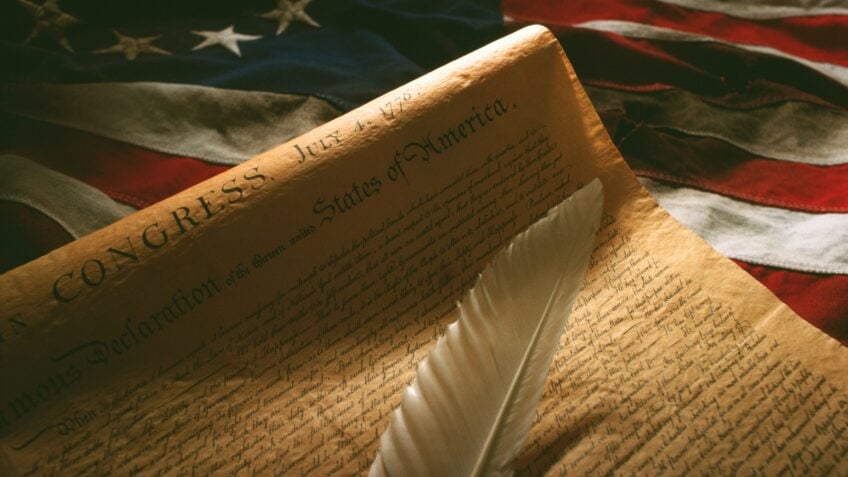
The Declaration of Independence is replete with immutable, universal truths – life, liberty, representative government, and the rule of law.
The final four grievances that inspired the Founding Fathers to break away from England centered largely on military transgressions. The signatories to the Declaration spoke against the attack facing the colonists on their own land and on the high seas.
Grievance 24 reads, “He has plundered our seas, ravaged our coasts, burnt our towns, and destroyed the lives of our people.”
As tensions rose between the colonists and the British, a series of skirmishes broke out throughout the colonies. The first major battle occurred on June 17th, 1775. Known today as The Battle of Bunker Hill, this two-hour conflict resulted in over 1,000 British casualties, 450 colonial casualties, and the destruction of the town of Charlestown, Massachusetts.
On October 18th, 1775, British Captain Henry Mowat was ordered to retaliate against the colonists for raids against British ships. His order from Vice Admiral Samual Graves was to “lay waste burn and destroy such Sea Port towns as are accessible to His Majesty’s ships.” Mowat chose Falmouth, which is now Portland, Maine, as his first target. After warning the town, leading the colonists to evacuate, Mowat’s fleet of six ships fired incendiary cannonballs, destroying over 400 buildings and leaving over 1,000 colonists without homes.
A few months later, John Murray, the last royal governor of Virginia, was defeated at the Battle of Great Bridge and forced to retreat to British ships off the coast of Norfolk. On January 1st, 1776, the British fleet fired upon the Norfolk waterfront, and colonial troops were secretly encouraged by their commanders to set fire to the city to raise support for the revolution. The burning destroyed two-thirds of the city and became a major driver in building support for the revolutionary cause.
Grievance 25 reads, “He is at this time transporting large Armies of foreign Mercenaries to complete the works of death, desolation, and tyranny, already begun with circumstances of Cruelty & Perfidy scarcely paralleled in the most barbarous ages, and unworthy the Head of a civilized nation.”
During the Revolutionary War, the British Empire was simultaneously fighting wars in Europe, India, and the Caribbean. This stretched the British military and led the king to hire about 30,000 German troops to fight the Americans. These mercenaries, also called “Hessians,” were known for their discipline and ferocity, which often involved plundering civilian property.
Grievance 26 reads, “He has constrained our fellow Citizens taken Captive on the high Seas to bear Arms against their Country, to become the executioners of their friends and Brethren, or to fall themselves by their Hands.”
In December 1775, the British Parliament passed the Prohibitory Act, which authorized the Royal Navy to seize colonial ships and impress colonial sailors to serve in the Royal Navy. Most of these colonial sailors joined the Sons of Liberty specifically to fight the Royal Navy’s harassment, as the act required them to fight in the navy they despised against the cause they supported. Impressment was not allowed under the ordinary rules of war and was seen as a cruelty by the colonists.
Grievance 27 reads, “He has excited domestic insurrections amongst us and has endeavored to bring on the inhabitants of our frontiers, the merciless Indian Savages whose known rule of warfare, is an undistinguished destruction of all ages, sexes, and conditions.”
Grievance 27 is actually two separate grievances. The first on “domestic insurrections” opposes Lord Dunmore’s Proclamation, which offered freedom to the colonies’ runaway slaves and indentured servants who joined the British fight against American rebels. The second critique is of England’s recruitment of “the inhabitants of our frontiers,” otherwise known as Native Americans, as allies against the colonists.
More than the earlier grievances, which were timeless pronouncements about freedom and representative government, Grievance 27 requires assessment through an 18th century lens. While exceptional, the Declaration of Independence signatories were men of their time. The Declaration of Independence affirmed that “all men are created equal,” but served as the rallying cry for a fledgling nation with a slave-dependent economic model.
George Washington characterized his ownership of slaves as “the only unavoidable subject of regret” and released his slaves in his will. Thomas Jefferson, who described slavery as a “great political and moral evil,” yet owned hundreds of slaves and likely fathered children with one of them – Sally Hemings. As they came of age, Jefferson or his will freed four of Hemings’ children.
Our Founding Fathers would undoubtedly be relieved that slavery was ultimately abolished. They expected their posterity to build on their work and ideas, with George Washington famously quipping that he didn’t believe the Constitution would last more than 20 years. The Declaration of Independence is replete with immutable, universal truths – life, liberty, representative government, and the rule of law. It was written by brilliant but imperfect men that, like all of us, were creatures of their historical era. Martin Luther King, Jr.’s observation that, “the arc of the moral universe is long, but it bends toward justice,” aptly describes our nation’s miraculous story.