
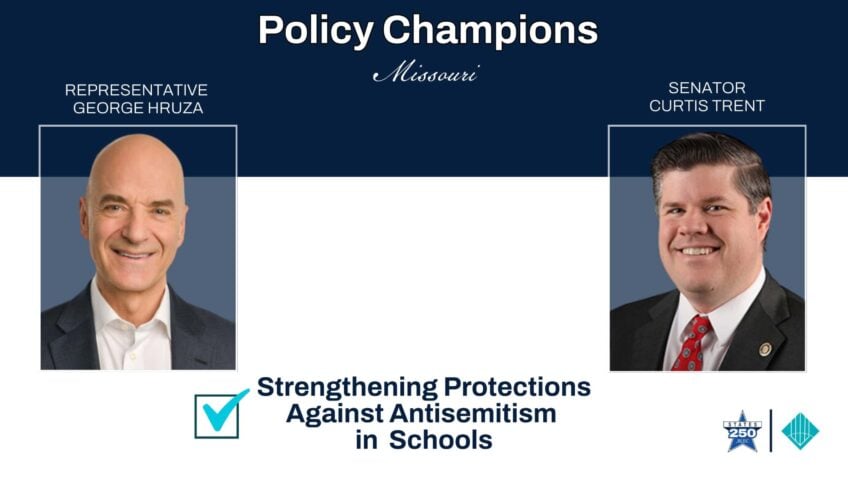
ALEC Policy Champions Strengthen Protections Against Antisemitism in Missouri Schools
We are honored to recognize ALEC’s latest Policy Champions, Missouri Rep. George Hruza and Missouri Sen. Curtis Trent, for their leadership in advancing HB2061, legislation that establishes a clear and actionable framework for addressing antisemitism in public educational institutions.
We are honored to recognize ALEC’s latest Policy Champions, Missouri Rep. George Hruza and Missouri Sen. Curtis Trent, for their leadership in advancing HB2061, legislation that establishes a clear and actionable framework for addressing antisemitism in public educational institutions. The bill also directs agencies to use widely recognized definitions of antisemitism, including the International Holocaust Remembrance Alliance (IHRA) definition, applying those standards across both K‑12 and higher‑education settings.
This aligns with ALEC’s models Act to Prohibit Anti-Semitism in State K-20 Educational Institutions and Act to Adopt the International Holocaust Remembrance Alliance (IHRA) Working Definition of Anti-Semitism, which use the IHRA definition as the standard for recognizing and combating antisemitic discrimination. ALEC alumnus Gov. Mike Kehoe signed the measure into law on April 23.
Last month, the U.S. House Education and Workforce Committee released a report on the rise of radical antisemitism on college campuses. The report highlights several key findings, including that university leadership and faculty play a critical role in preventing and correcting hostile antisemitic environments. It also notes that certain student groups have consistently acted as catalysts for antisemitic harassment, and that colleges and universities across the country have frequently failed to meaningfully discipline students engaged in such conduct, thereby creating conditions that enable further misconduct.
However, states are stepping in to provide clarity and accountability. Missouri’s HB 2061 is the latest example of this state‑led approach and does something simple but important: it ensures that when reports of antisemitic harassment or disparate treatment occur, state investigators have clear, consistent standards to evaluate those claims.
The legislation targets antisemitism on college campuses and in K‑12 classrooms by requiring schools to report incidents to Title VI coordinators within the Departments of Elementary and Secondary Education and Higher Education. These coordinators must establish, maintain, and publicize a formal reporting process for students, parents, staff, and faculty to submit complaints of antisemitic discrimination or harassment. They are also required to investigate each complaint thoroughly.
If, after a reasonable investigation, a coordinator determines that an institution has engaged in or failed to prohibit antisemitic discrimination sufficiently, the department must notify the institution in writing. Upon receiving this notice, the institution is required to address the issues identified in the determination within 30 days. Additionally, coordinators must compile and publish an annual report detailing all complaints that were monitored, reported, and investigated.
Furthermore, HB 2061 requires schools to outline prohibited antisemitic conduct in their codes of conduct, including penalties for harassment, while prohibiting institutions from creating lists or databases of students based on religious or political beliefs.
This is the kind of limited‑government, civil‑rights clarity that states are uniquely positioned to provide. Rather than expanding state power, HB 2061 sharpens the tools that already exist. It tells publicly funded institutions, which have a responsibility to protect all students, exactly how to apply anti‑discrimination law when antisemitism is involved.
HB 2061 also reflects a broader principle that ALEC has long emphasized: accountability in public institutions. ALEC models such as the Forming Open and Robust University Minds (FORUM) Act and the Free Speech in Higher Education Act underscore the expectation that publicly-funded schools and universities uphold basic civil‑rights protections while safeguarding free expression. When those protections fail, states have both the authority and the obligation to intervene.
Since Hamas’s savage Oct. 7, 2023, attack against Israel, antisemitic incidents have steadily increased each year globally and domestically. This crisis is most evident in our educational institutions, where 4 in 10 Jewish students report experiencing antisemitism. This resurgence of the “world’s oldest hatred” presents an immediate and escalating threat to Jewish communities everywhere. It became personal this year, as a local Maryland synagogue, Shaare Tefila, where signs were spray-painted with hateful messages and symbols, is the shul attended by the co-author of this article.
We congratulate Rep. Hruza and Sen. Trent for their leadership and wisdom on HB2061. Missouri’s approach is measured, focused, and aligned with a growing national consensus. As other states consider how to respond to rising antisemitism in education, HB 2061 and ALEC’s models offer a road map for strengthening protections without compromising free expression or expanding government overreach.