
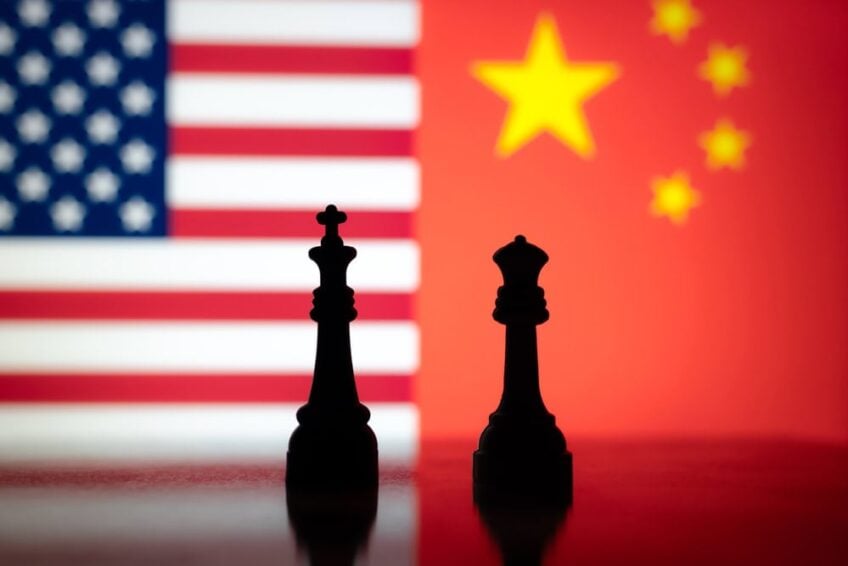
The Trump-Xi Summit: Much at Stake at a Time of Geopolitical Upheaval
China remains America’s most serious, complex threat and a designated U.S. foreign adversary.
Originally scheduled for March, a Summit between Presidents Donald J. Trump and Xi Jinping of the People’s Republic of China (PRC) takes place in Beijing this week on May 14-15. This is the first state visit of a U.S. president to Beijing since Presidents Trump and Xi met in China in 2017.
This week’s meeting was postponed presumably to allow time to conclude the Iran conflict to avoid the awkwardness of talks with the PRC, which is Iran’s largest oil customer and is providing intelligence and defense components to the theocracy. It is significant that both leaders rejected delaying talks despite a ceasefire that President Trump described as “on life support,” suggesting that they will arrive with initiatives to advance.
Heading into the meeting, President Xi, whose officials have described the United States as a “giant with a limp,” believes he has the upper hand. Some of the more contentious bilateral trade disputes were settled at the Busan Meeting in October 2025; however, the Board of Trade’s efforts to formalize and rebalance bilateral trade flows for “nonsensitive goods” are on this week’s docket, with hopes for an agreement to increase PRC imports of U.S. agricultural products.
President Trump’s obvious irritation over PRC arms shipments to Iran hints that China’s Iran assistance is on the table, as China’s Russia aid should be.
Read more about PRC support for the Kremlin’s war effort: China, Russia and Ukraine: An Overlooked Moment at the Munich Security Conference
Presidents Trump and Xi are expected to discuss AI safety frameworks and “preventing the release of certain dangerous capabilities.” However, PRC commitments to AI regulation are unreliable. Loosening export controls on the high-end chips that China wants should not be under consideration, as the U.S. needs to maintain its edge in the AI innovation race to prevent dependence on and PRC weaponization of AI technology.
Both leaders have acknowledged that Taiwan will be discussed. President Xi will press President Trump to reduce or eliminate arms shipments to Taiwan and deprioritize Taiwan’s sovereignty. The White House’s response should be to underscore the enduring strength of the U.S.-Taiwan partnership. The record $11 billion defense package authorized in December by Congress needs to be delivered to send a strong message to the PRC that Taiwan’s freedom is an American priority.
China routinely tests boundaries of delegitimizing the island nation, often invoking United Nations General Assembly Resolution 2758. Most recently China effectively denied overflight for President Lai’s plane for a visit to Eswatini.
Read more about the issue here and here, and access ALEC model policy here.
Now is the time to stand firm, as countries like Honduras consider rejecting Beijing and renewing diplomatic relations with Taiwan. Honduras realized that PRC promises of investment are often empty, and that bowing to PRC pressure in a vain attempt to secure the elusive deal generally backfires.
Although not comprehensive, the ALEC Statement of Principles on Policies Relating to the People’s Republic of China provides the White House with a useful guide of negotiation priorities for some issues. President Trump has signaled that securing the release of Apple Daily Newspaper founder and Hong Kong democracy champion Jimmy Lai would be on the agenda. At 79, Lai is in fragile health, so his freedom would be a very welcome victory for those who courageously oppose tyranny, and would fulfill the Respect Human Rights and Protect Dissident Communities segments of the ALEC Statement.
China remains America’s most serious, complex threat and a designated U.S. foreign adversary. While managing bilateral relations with the PRC is important, America needs to be clear on what will not be compromised for the illusion of stability. The PRC continues to expand its influence globally, including as the de facto leader of the club of autocracies that includes Iran, North Korea, and Russia, with hopes of becoming the number one tourist destination by 2030, as visits to the U.S. decline.
Last year, Beijing warned that exports of critical minerals and magnets to the U.S. would be suspended, a familiar coercive tactic, forcing the White House to reverse steep tariffs and notching a perceived PRC win. While U.S. imports of Chinese goods have declined, China cultivated new markets finishing, 2025 with a record $1.2 trillion trade surplus, mitigating the potential economic damage of America’s remaining tariffs. China’s dominance in critical and rare earth minerals processing gives it the power to halt 21st century innovation for the U.S. and its allies, and the PRC actively undermines America’s global economic prominence through initiatives like the mBridge project, touted as an alternative to the SWIFT system and Petrodollars.
This is an all-hands-on-deck moment, and joining with our global partners is the most effective way to check China’s economic coercion and strategic threat potential. Countering PRC domination can only be accomplished with a little help from our friends.